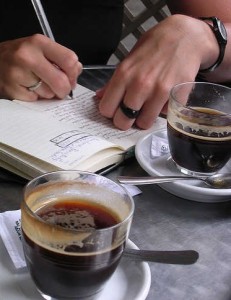


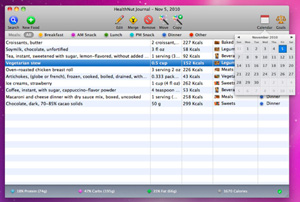



There may be one more reason to put pen to paper when it comes to tracking what you eat, especially if you’re a woman.
A new study from the Fred Hutchison Cancer Research Center in Seattle, Washington, found that women who keep food journals, skip fewer meals and eat out for lunch less frequently lose more weight than women who don’t.
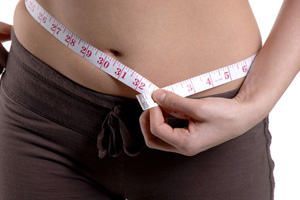
To conduct the year-long study, researchers tracked the eating habits of 123 overweight or obese post-menopausal women who were following a weight loss regimen. At the end of the study, the women had lost an average of 19 pounds, or roughly 11 percent of their starting weight.
The majority of the women were advised to follow a 1,200 to 2,000 calorie-a-day diet, depending on their needs, and record everything they ate in a food journal.
Researchers speculate that the women successfully lost weight because writing down what you eat forces you to become more accountable and stick closely to your weight loss program.
Read Full Post >
Anyone can start a weight loss program. All it takes is a modicum of willpower and a loose plan. There are even mainstream services, such as Weight Watchers, that can provide a guide. The difficult part, and the part where most people fail, is following through. Willpower can take us only so far. We need something extra in order to stick with our plans for the long haul.
The intersection of two recent ideas can perhaps provide a solution. Both feedback loops and the quantified self involve recording data, and then viewing that data from multiple angles. It makes us aware of our behaviors and habits, and awareness is the first step to change.
Using technology to our advantage
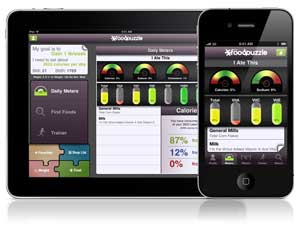
Perhaps the biggest issue in creating feedback loops and achieving the quantified self is the actual recording of the data. After all, feedback loops only work if we can place our habits and behaviors in front of us. Thankfully, smartphones — devices we have with us at almost all times — can play a large role in data recording. There are apps specifically designed with feedback loops and the quantified self in mind for dieters.
Read Full Post >
Now introducing FatApp: the delightfully backwards way to food journal that may be the answer you are looking for.
Food journaling sucks. Whipping out your little notebook or phone to log every bite you put into your mouth is depressing. It doesn’t make you think twice about eating that Oreo your kid dropped on the floor, oh no, it just irritates you so you don’t log it down at all, which then makes your journal an inaccurate recording of what you’ve actually eaten which is why you aren’t losing weight.
FatApp is a food journaling app, but instead of recording what you do eat, (ie. lint covered Oreos) you log what you didn’t eat (the 3 you almost stole out of your kid’s lunch box.) Every bite you don’t eat is a success. Every little extra this and added dash of that you pass up is a small victory you can log. At the end of the day, you can look back at all of your achievements and feel pride instead of seeing the stuff you “shouldn’t” have had.
The app isn’t just for skipping dessert when it’s offered, or opting to only drink black coffee until your lunch break, it’s about making small, manageable changes that can really add up. Choose a non-fat latte over full fat? Log about 50 calories saved. Only ate half of a donut? Instead of chastising yourself for eating half a donut, you can pat yourself on the back for not eating the other half.
Read Full Post >
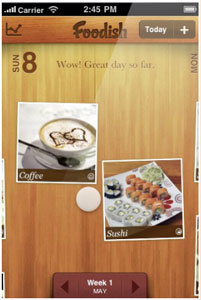
There are many food journaling apps out there, and most of them are geared towards helping users count calories and lose weight. The Foodish iPhone app takes the diet journal in a new direction. The user takes photos of their meals and the app keeps a record, allowing the user to give each item a rating with an emoticon. You can then share your pic on Twitter and Facebook.
The makers of the app describe it as “the elegant and modern way to track a diet for all those who don’t want to mess scales and calories.” Basically, the app will not tell you if your meal was healthy or not, but it can help you be more aware of what you’re eating and how much. This is particularly true because you have to photograph your food before you eat it, allowing you enough time to think twice. If you’re looking for an app that will inform you about the nutritional value of the foods you’re eating, you will be better off with something like FoodFacts or Fooducate.
Read Full Post >
This week’s episode of Shedding for the Wedding started off with a challenge to win dream flowers for each couple’s dream wedding. The couples had to race towards a table that was laden with flowers, while also pulling against the tension harnessed that had them penned to a fence. The winning couple was Valerie and Dave. Along with their dream flowers, they got to penalize another team with a one-pound penalty in the next weigh-in. They choose Allison and David, aka Team Fairy Tale.
A big issue surfaced during this episode concerning food and the food journals the couples have been instructed to keep. It turns out that some of the women on the show – Valerie an Taylor – were not keeping track of what they were eating or how much they were eating. At one point, Taylor claimed she was only eating 600 calories a day. After some investigation, it was discovered that Taylor probably ate 600 calories in her breakfast alone and that she could not even remember everything she had eaten that day. It became even more apparent that Taylor was eating a lot more than a mere 600 calories a day; at the elimination weigh-in, we learned she had gained two pounds this week. Obviously, Peter was very upset about this and cussed.
Read Full Post >