Not only does too much homework negatively affect students’ test scores, but new research suggests that even an hour or two of homework each night gives no measurable advantages to students before they enter grades 10 through 12. Sydney University’s Richard Walker headed up the study outlined in his new book “Reforming Homework: Practices, Learning and Policies.”
According to the study, students in elementary school get limited benefits from homework, while middle schoolers get slightly more. It’s not until high school that academic performance becomes enhanced with homework. Even then, too much homework can lead to poor mental and physical health. A lack of sleep is one cause of this, with one study linking sleep deficiencies in teens to obesity. A lack of sleep can also lead to diabetes, another study found.
Read Full Post >
I must say that I was a bit disappointed to read a press release this morning about a new dietary supplement to help college students manage procrastination. I cannot blame Genius Labs, LLC. for trying to make a buck, and they probably have a market, but it is disappointing that they can spell out that a healthier diet generally equals a higher GPA, yet many will see their supplement as the answer rather than improving diet.
I did find it interesting that they linked poor diet, along with the tendency for up to 95% of college students to procrastinate tasks, to the statistic of one in every four college students illegally using ADHD medications like Adderall. We know that a healthier diet for ADHD can help those diagnosed, why do we just accept that college students, in general, won’t eat well?
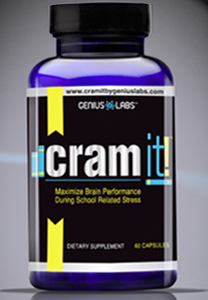
Genius Labs, LLC. describes themselves as “a Baltimore-based privately held dietary supplement company that focuses on developing proprietary supplement blends that maximize brain health and performance. Founded by an MBA student searching for a natural mental edge; the firm targets college students that often cram to complete school work and study for tests.” Their new product Cram It! is a blend of omega-3 and various herbs, vitamins, and minerals with little caffeine that they claim “supports memory and the ability to analyze complex ideas.”
Read Full Post >
by Kelsey Murray
Pierre Dukan is the author of The Dukan Diet, and his books have sold millions of copies around the world, thanks in no small part to being Kate Middleton’s rumored diet. Now, the author is dipping his toes into the political arena by offering advice concerning the national obesity problem.
Dukan suggested to the future president of France that students should receive higher marks for staying within a specified body mass index range.
“For those who don’t need to lose weight, it wouldn’t change anything,” said Dukan. “For the others, it would motivate them.”
Dukan says that half of the population is overweight and that this trend has doubled in the past 12 years. He seems to think that targeting students under the age of 18 is one way to curb this problem.
Read Full Post >
How many times have any of us ever forgotten our lunch? It’s a pretty mundane event, we either skip or find a plan B and move on with our day. For Sarah Wu, it was not a common occurrence to leave her lunch at home. Making lunches for she and her toddler son was a part of her routine. However, one fateful day she did forget her lunch and what happened after that changed her life.
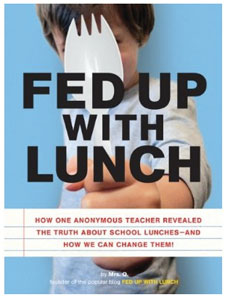
Sarah is a speech pathologist for Chicago Public Schools, and in 2009 she was working in one of the largest and poorest schools in the city (she remains there today). She forgot her lunch, but felt a little relief because for three dollars she could walk to the cafeteria and pick up that day’s hot plate. She admits to having ” a minimal understanding of food and scratch cooking” but upon receiving her school lunch that fateful day, she said “I knew there was something wrong with that meal.”
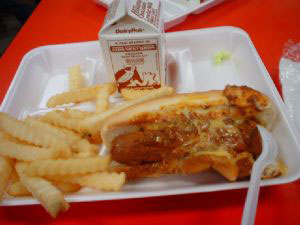
It was a bagel dog, a hot dog encased in a starchy white bagel crust, that was pretty soggy. This was served with a handful of tater tots (which qualifies as a vegetable serving), a Jell-O cup (a qualified fruit serving), and a chocolate milk. Almost immediately Sarah became “Fed Up With Lunch,” the title of her blog-turned-book in which she “outs” the goings on of the school cafeteria and how our children are being fed nothing more than processed, chemical junk.
“I didn’t think there was much I could do,” Wu told us, who took on the pen name “Mrs. Q” to protect her fragile anonymity. She agonized for weeks over what she was seeing at school before she finally started her Fed Up With Lunch blog, where she committed to eating lunch in the school cafeteria every day for an entire school year. She photographed the meals each day, all of which are shared in a photo insert in the book, and wrote about what she was served, what she was learning about the school food industry, and even the effects she was seeing on her students as a result of these meals.
Read Full Post >
Houses across America have either already been inundated with bucket loads of candy, or they’re starting to brace themselves for Sunday night’s onslaught. Kids aren’t the only victims of the sugar high and calorie binge that’s about to take place, moms and dads are just as, if not more, likely to dip their hands into the trick-or-treat stash. 
What to do? Sure you could handout toothbrushes… but really? Temporary tattoos, scary baby carrots, goody bag yo-yos and sugar-free gum are all healthy alternatives, but where’s the fun in that? Put that candy to good use!
Go ahead and let your kids rake in as much candy as possible. Then, spend an afternoon experimenting with the candy! Instead of burning brain cells on refined sugar, fuel their brain cells with fun-filled knowledge.
We cruised around the Web and found some pretty cool candy experiments. All of these make for some cheap fun that uses all that Halloween loot in a practical, fun and non-wasteful way. Just like in high school chemistry… don’t eat anything in the lab!
Read Full Post >