


I’ve had kids playing sports for more than 15 years (just typing that out makes me feel so, so old) and time and again, I’ve noticed one thing that just about every practice or game has in common.
Doesn’t that surprise you? It just doesn’t make sense to me. Admittedly, I’m a self confessed health food aficionado – although I have been known to dig into some french fries time and again – but I really have a hard time with the foods that many kids are offered after a difficult game. My kids have been given corn chips, candy bars, fruit snacks, squishy fruit punch pouches and even sodas. Rarely are there healthy choices offered.
I’ve been the team mom many times, and although I have often requested that healthier snacks be offered, the overwhelming concern is that kids just won’t eat them. A Sports Moms Study, funded by PepsiCo, found that more than 70% of moms are raising kids in competitive sports. The study found that sports moms spend 1/3 more time and more than twice as much money across their children’s extracurricular activities than those families without kids in sports. According to the study, the area in which most moms feel that they have the highest level of influence is their athlete’s nutrition. Read Full Post >
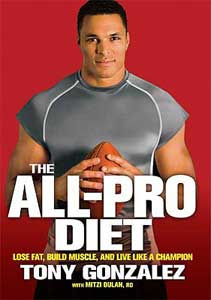
Take one part sports dietitian, mix with one part professional football player, and add a dash of whole food recipes. Pop it in the oven and eventually you get an excellent book called “The All-Pro Diet: Lose Fat, Build Muscle, and Live Like a Champion” (Rodale, 2009).
I sat down with Kansas City Chief’s Tony Gonzalez’s sports dietitian and co-author Mitzi Dulan, RD to get an idea about what the book has to offer people trying to lose weight. Mitzi explains how eating mostly whole plant foods and avoiding heavily processed foods can help you manage a healthy weight.
Listen now as we discuss some of the recipes in the book, like the coconut banana smoothie. YUM!
The closest I ever got to the Olympics was the USOC training center in Colorado Springs where I received sports nutrition training. As I write this, The USOC dietitians are in Vancouver with Team USA making sure they are well hydrated and fueled while they go for gold.
But what exactly do Olympic athletes need to eat? You probably heard the stories of Michael Phelps chowing down on 10-15,000 calories a day! It sounds like a dream come true. Believe it or not, many of the winter sports require smaller body sizes to excel. It’s no wonder there is concern for eating disorders to develop among athletes.
For example, the ski jumper must be tall and thin so their goal is to have a low BMI – 5′ 11″ and 140 pound male (model thin). Suzie Parker Simmons, a sports dietitian at USOC, says that ski jumping is problematic because the sport requires strength, power and low weight. “Because it’s a power sport, endless hours of fat-burning running [to reduce weight] is counterproductive athletically—explosive power for ski jump demands fast-twitch muscle fibers, not the slow-twitch fibers developed by endurance sports. That means caloric restriction, not extra exercise, is the primary means of keeping body weight low.” Read Full Post >
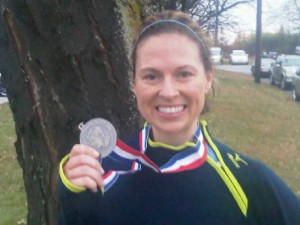
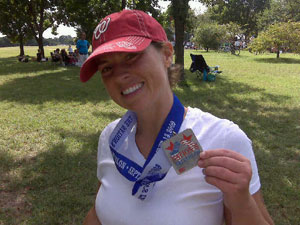
Marathon schmarathon. When 26.2 becomes routine, one goes searching for a distance that appears more challenging. So how about a 50 mile foot race? The JFK 50 is America’s oldest 50 miler. At 5:00 a.m. on November 21 I started my journey in the dark somewhere in Maryland. At 4:30 p.m. that day, somewhere 50 miles further away, I collected my medal for completing the ultra endurance race. It was amazing.
Wondering if a 50 miler is in your future? Read on to find out more what it’s all about and decide if you’d like to add it to your bucket list. Read Full Post >
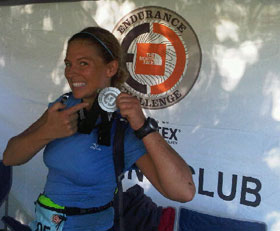
Because completing my first Olympic distance triathlon was not enough, I decided to follow up a week later with my first ultra marathon – a 50K (31 mile) trail race in The North Face Endurance Challenge series! If you’re surprised, trust me, I was too! I actually thought I was competing in a 20-miler! But, you know what, when it came down to it, I trusted myself and my nutrition fueling plan. I just committed to having fun.
Here’s how I survived my ultra marathon:
Carb-load - Carbs are gasoline for the body and you can’t attempt a 50K without putting gas in the tank. I had two cups of whole wheat pasta with marinara sauce and some salted steak fries the night before my run.
Early riser breakfast – I woke at 4 a.m. for a 7 a.m. start and I noshed on a toasted plain bagel with almond butter, a banana, and water. Read Full Post >