Diets in Review - Find the Right Diet for You

usda


Government Bails Out Chicken Factory Farmers

Chicken in a cageThe demand for chicken in the US is down, and we can only speculate as to why. Many argue that tough economic conditions have caused Americans to decrease their meat consumption and opt for lower-cost foods. Chicken inventories are 13.1 percent higher than they were a year ago, according to a Wall Street Journal article.

In response to the gap between product and demand, the U.S. government is making a special purchase of 40 million dollars worth of chicken products, which will be distributed to school lunch programs and soup kitchens.

“Thanks to prevailing price trends, the government is getting a bargain on high-quality food to help meet the nutritional needs of the clients of these programs, while the industry is getting some relief from excessive inventories,” said National Chicken Council President Mike Brown. USDA Secretary Tom Vilsack also praised the deal, saying “it will also provide support to the broiler industry and the many small independent poultry growers that depend on the industry for their livelihood.”


Read Full Post >


Starbucks’ Ready-To-Eat Chicken Products Recalled

UPDATE [7/27/11]: This recall has been expanded to include Starbucks salami and cheese Bistro Box and the chipotle chicken wrap. There has also been a separate recall of Pilgrim’s Pride chicken nuggets.

Those that frequent Starbucks coffee shops in Georgia and Alabama will want to be on the lookout for chicken products that have been recalled recently. Flying Food Group is the company that produces the Starbucks Chipotle Chicken Wrap Bistro Box and the Starbucks Chicken and Hummus Bistro Box. They have recently recalled both of these products due to Listeria monocytogene contamination.

Roughly 204 pounds of ready-to-eat chicken wraps and plates are being recalled in total. The products that are recalled have “Enjoy by 071511” on the bottom left corner of the package. They also have an establishment number of P-34373 within the USDA mark of inspection.

This problem was discovered through microbiological testing conducted by the USDA’s Food Safety and Inspection Service or FSIS. There were no reports of illness with these products, but the FSIS routinely conducts recall effectiveness checks, which is how the contamination was found.


Read Full Post >


Picturing the American Diet

WWII Poster of the Basic Food GroupsThe food pyramid, long an iconic part of an American education, was retired by the USDA in favor of MyPlate, a simplified icon to help us eat better at every meal. Coinciding with the announcement, The Foundation for the National Archives has curated an exhibit called “What’s Cooking, Uncle Sam?” which takes an in-depth look at how the U.S. government has worked to guide the way its citizens eat.

The National Archive’s exhibit uncovered a fascinating poster from World War II (shown left). Perhaps the most surprising thing about this image that butter is its own food group, but it also gives a glimpse into a moment in American history when rationing threatened to leave those on the home front potentially underfed and malnourished.

Less than seventy years later, the country faces an epidemic of obesity, particularly among its children. MyPlate is offered to U.S. citizens as a tool to reduce calories, eat more fruits and vegetables and understand portion sizes.


Read Full Post >


New USDA MyPlate Icon Fills Plate With Less, Says Cheryl Forberg, RD

Cheryl Forberg, RD is a James Beard Award-winning chef, New York Times best-selling author, and nutritionist for NBC’s “The Biggest Loser.” Her latest book is “Flavor First,” which can find out more about at Flavorfirst.com. You can follow her on Twitter @cherylforbergrd.

Why were nutritionists so happy when the USDA announced the food pyramid was dead?

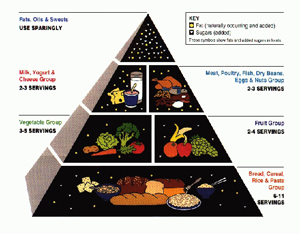
When the USDA in 1992 released the food pyramid we’ve all become familiar with, many nutritionists voiced concerns with the diagram. The large base of bread, cereal and grains just gave the impression that you were supposed to eat so much more from that group. Encouraging people to eat so many grains and carbs, nutritionists argued, paved the road to an obesity epidemic.

The original pyramid had long been unpopular and in 2005 it was replaced with a new logo called MyPyramid, a nearly impenetrable glyph depicting a stick figure running up steps on the side of a vertical striped pyramid. Sensitive to fears that the hierarchy of the original could lead to an improper balance, the USDA abstracted the image and turned the breakdowns on their side. The running figure was meant to to remind people that exercise was an important component of proper diet and nutrition. Too bad nobody paid much attention to the essentially meaningless graphic.

Thursday, First Lady Michelle Obama, Agriculture Secretary Tom Vilsack and Surgeon General Regina Benjamin unveiled the USDA’s new food icon, replacing the confusing pyramid with MyPlate.
Read Full Post >


USDA Announces New Bio-Based Product Label

Sample Eco labelAmong the many products clamoring to get attention for their “green” credentials, real or purported, it can be difficult to tell which items are genuinely eco-friendly from the green-washed impostors. To help discerning  consumers, the U.S. Department of Agriculture’s BioPreferred program announced yesterday that they will be offering a new, voluntary seal for bio-based products.

Similar to the USDA Organic label and the Energy Star seal, the new “USDA Certified Biobased Product” seal aims to steer consumers towards products that are made from renewable resources. “Today’s consumers are increasingly interested in making educated purchasing choices for their families,” said Agriculture Deputy Secretary Kathleen Merrigan in a press release. “This label will make those decisions easier by identifying products as biobased. These products have enormous potential to create green jobs in rural communities, add value to agricultural commodities, decrease environmental impacts, and reduce our dependence on imported oil.”


Read Full Post >