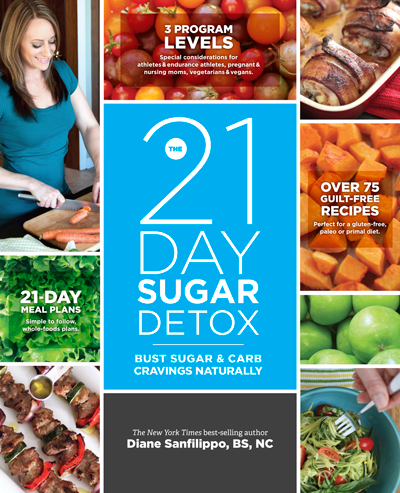
Around the holidays I found myself suffering from a cold. Since going gluten-free and dairy-free, it’s an anomaly for me to need an anti-histamine or decongestant. Knowing how sugar impacts the immune system, I assumed one of the culprits must be the holiday sweets I was consuming, even though it was in moderation. When I received the book the 21 Day Sugar Detox by Diane Sanfilippo as a Christmas gift, I decided that I would give the program a try starting January 1.
Last year around this same time, I completed approximately 16 weeks of a three-level allergy-detox (stopping when I had lost too much weight). The programs did not seem all that different so I didn’t think it would be that difficult to go 21 days.
One of the most important things I have learned about dietary change is that restriction can lead to binging. If we feel limited, desire increases and takes on more importance. During my allergy detox, while I constantly had to check my list of approved foods, I was able to eat as much steak and eggs or bacon burgers (no bun) as I needed to. While I realize not everyone agrees, I don’t have a problem with eating fats.
Pamela Reilly, ND, CNHP, MH, CWHP, is a Naturopathic Physician and speaker that I trust with my own health and wellness. She designed the allergy-detox program that I completed last year. She clarifies that “if an eating style is extremely restrictive it is not intended to be permanent.”
I do think part of the secret to success is making sure that you do not feel restricted and finding indulgences when you need them. Sometimes you really do just need to make it just a few more hours before the craving subsides. On the other hand, over indulging does not do your body any favors.
Even if the indulgence is something like grapefruit—too much of even a good thing is still too much. Reilly believes that “people who truly want to change react really well to restrictions”; however, she adds that she “always provides substitutes when telling people to remove something” because she believes “it’s a lot healthier to function from an abundance mindset and to focus on the benefits and not what you are eliminating.” (more…)