

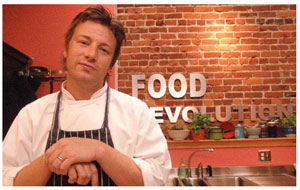
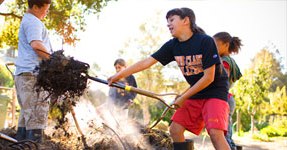
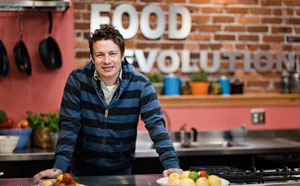


After the disappointment in the last episode of Jamie Oliver’s Food Revolution, it was a wonderful surprise to see that the administrator of West Adams High had hopefully found a loophole, so that Jamie and his kids could indeed cook for the entire school, at least as an assembly. The administrator said that the school was based on experiential teaching and preparing kids for college, so healthy eating fit right into their principles. In the mean time, Jamie continued his role of instructor, trying out different subjects beyond culinary arts.
In math class, Jamie taught about calories and consequences by allowing students to choose a snack between soda, chocolate bars, pizza, or oranges. He then allowed them to experience weight gain using weight backpacks. Jamie then took his math students out to the track having the students walk around the track enough times to burn the calories of what they had just eaten.
Read Full Post >
If you are like me, you didn’t realize that ABC had snuck Jamie Oliver’s Food Revolution back into the line up on a new day and time. Luckily, I was able to catch up on Hulu.com. Hopefully, the rest of the season will continue on Fridays at 9p EST.
In the third episode of the second season, Jamie finally made some progress with Deno at Patra’s who we saw last episode. Jamie offered to renovate the entire diner and join him live on Ryan Seacrest’s radio show if Deno would agree to upgrade the meat in his burgers from the patties he knows nothing about. Deno said that his concern was more about if his customers would like it rather than the extra 13 cents per patty, but he also spoke about the “bottom line” a lot in this episode. Jamie introduced Deno to Sophia, one of the students from West Adams High, who shared her story and her concern that fast food is the primary contributor to diabetes in her entire family.
I was appalled that Deno would argue to a crying teenager that fast food is a choice, just like alcohol or cigarettes. When a child is given fast food, whose choice was it to purchase it? When lower quality ingredients are used to make foods, whose choice was that? Yes, I choose not to eat fast food, and my coworkers have said they hide their “bad” lunch choices from my sight. Yet, I am disturbed by the lack of compassion and the choice to blame rather than to take responsibility for one’s own choices.
Read Full Post >
The premier of season two of Jamie Oliver’s Food Revolution was better than I had hoped. It had everyone in my house shocked and engaged. I couldn’t keep up with the discussion on twitter because #foodrevolution was a trending topic with hundreds of tweets every minute. If you missed it this week, I will catch you up. Hopefully you can join the conversation tweeting live with us next week.
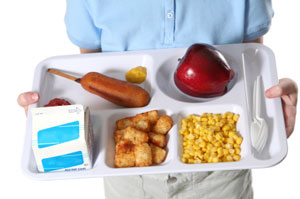
This season Jamie is in Los Angeles, but he has been banned from the LAUSD school system. Even after going before the school board, not like a celebrity but like any other citizen in a three minute slot, Jamie was dismissed unceremoniously. At one point, Jamie stated that his welcome in Huntington, WV, reportedly the unhealthiest city in the U.S., was warm compared to the cold shoulder he was receiving in L.A. Because he was not allowed in the schools, he asked school children and their parents to bring him food items from the school. Jamie stated that it was the worst school menu he had seen anywhere (and twitter seemed to agree). It was revealed that to save money, food is only prepared in one kitchen for all the schools in L.A. – the meals were only warmed in house.
Read Full Post >
The beginning of the year marked a turning point for schools in Mexico. In order to fight childhood obesity, a soda ban and new food guidelines were put into place. Unfortunately, the new food rules are proving to be too relaxed for the taste of some officials.
Mexico is among the most obese countries in the world and children are far from exempt in these statistics. To put it into numbers, one out of every three children in Mexico is overweight.
Schools in Mexico do not provide school lunches, but food and snacks are sold at recess. After long and painful negotiations with junk food moguls, officials stepped in to mandate what type of foods are allowed to be sold. Although considerable improvements were made, there is still a great need for change. Chips, candy and cookies continue to be readily available for children to purchase during school hours. After school, the situation worsens beyond the reach of the newly-set standards. Vendors eagerly wait outside for the throng of students to come pouring out. Nachos, ice cream and various confections tempt the children after a long day in class.
Read Full Post >
President Obama’s State of the Union address came at a politically fortunate time in his presidency. On the heels of the Arizona tragedy that took the lives of six people and injured 13 others, including congresswoman Gabrielle Giffords who is still bravely fighting through her ordeal, the president has political capital to espouse some of his most prized initiatives to Congress and the rest of the country.
This tragedy has in some small way helped unify the country around President Obama after his well-received speech in Arizona… at least for the 53 percent or so who approve of the work he is doing as president, a dramatic turn from the low forties he was in just a few months ago.
The central themes to Obama’s 2011 State of the Union address were education, moving the country forward in the technologies of the future, and how we need to prepare the workforce for the 21st century economic realities.
Read Full Post >