<?xml version="1.0" encoding="UTF-8"?>
<rss version="2.0"
	xmlns:content="http://purl.org/rss/1.0/modules/content/"
	xmlns:wfw="http://wellformedweb.org/CommentAPI/"
	xmlns:dc="http://purl.org/dc/elements/1.1/"
	xmlns:atom="http://www.w3.org/2005/Atom"
	xmlns:sy="http://purl.org/rss/1.0/modules/syndication/"
	xmlns:slash="http://purl.org/rss/1.0/modules/slash/"
	>

<channel>
	<title>Diets in Review Blog &#187; salt</title>
	<atom:link href="http://www.dietsinreview.com/diet_column/tag/salt/feed/" rel="self" type="application/rss+xml" />
	<link>http://www.dietsinreview.com/diet_column</link>
	<description>Diet Column - bringing you all the best diet news and opinions</description>
	<lastBuildDate>Sun, 22 Nov 2009 06:00:39 +0000</lastBuildDate>
	<generator>http://wordpress.org/?v=2.8.5</generator>
	<language>en</language>
	<sy:updatePeriod>hourly</sy:updatePeriod>
	<sy:updateFrequency>1</sy:updateFrequency>
			<item>
		<title>Too Much Salt on Restaurant Menus</title>
		<link>http://www.dietsinreview.com/diet_column/06/too-much-salt-on-restaurant-menus/</link>
		<comments>http://www.dietsinreview.com/diet_column/06/too-much-salt-on-restaurant-menus/#comments</comments>
		<pubDate>Thu, 04 Jun 2009 15:20:43 +0000</pubDate>
		<dc:creator>Jason</dc:creator>
				<category><![CDATA[Nutrition & Health]]></category>
		<category><![CDATA[menus]]></category>
		<category><![CDATA[restaurants]]></category>
		<category><![CDATA[salt]]></category>
		<category><![CDATA[sodium]]></category>
		<category><![CDATA[webmd]]></category>

		<guid isPermaLink="false">http://www.dietsinreview.com/diet_column/?p=8891</guid>
		<description><![CDATA[Even the most dedicated health nut likes to go out on the town and grab a bite at a good restaurant. But that&#8217;s often fraught with dietary land mines. Every patron is fighting a losing battle with all the salt that restaurants add to their cuisine.
According to the consumer watchdog group the Center for Science [...]]]></description>
			<content:encoded><![CDATA[<p><a href="http://www.dietsinreview.com/diets/Low-Sodium-Diet/" ><img class="size-full wp-image-856 alignleft" title="salt" src="http://www.dietsinreview.com/diet_column/wp-content/uploads/2008/07/salt1.jpg" alt="salt" width="150" height="279" /></a>Even the most dedicated health nut likes to go out on the town and grab a bite at a good restaurant. But that&#8217;s often fraught with dietary land mines. Every patron is fighting a losing battle with all the salt that restaurants add to their cuisine.</p>
<p>According to the consumer watchdog group the Center for Science in the Public Interest, restaurants are increasing their customers&#8217; chances of <a title="high blood pressure" href="http://www.dietsinreview.com/diet_column/05/beat-high-blood-pressure-with-beets/"  target="_self">high blood pressure</a>, heart attack, and stroke with all the salt they add to their food.</p>
<p>Among 10 popular chain restaurants examined, about 85 percent of the adult meals have more than the <a title="sodium recommendations" href="http://www.dietsinreview.com/diet_column/03/70-of-us-adults-eat-twice-as-much-salt-that-they-need/"  target="_self">recommended daily sodium intake</a> (which is &gt;2,300 mg). Here are some examples given:<span id="more-8891"></span></p>
<ul>
<li>Red Lobster&#8217;s Admiral&#8217;s Feast at 7,106 milligrams of sodium. The meal includes lobster, Caesar salad with dressing, lobster-topped mashed potato, biscuit, and lemonade.</li>
<li>Chili&#8217;s Buffalo Chicken Fajitas and a Dr. Pepper at 6,916 milligrams of sodium.</li>
<li>Chili&#8217;s Honey Chipotle Ribs at 6,440 milligrams of sodium, which includes mashed potatoes with gravy, seasonal vegetables, and Dr Pepper.</li>
<li>Olive Garden Tour of Italy lasagna at 6,176 milligrams of sodium, with a bread stick, salad with house dressing, and a Coca-Cola.</li>
<li>Olive Garden Chicken Parmigiana at 5,735 milligrams of sodium, with breadstick, salad with house dressing, and raspberry lemonade.<a href="http://www.dietsinreview.com/diet_column/07/20-saltiest-foods-in-american-restaurants/" ><img class="alignright size-full wp-image-813" title="restaurant dining" src="http://www.dietsinreview.com/diet_column/wp-content/uploads/2008/07/restaurant-dining.jpg" alt="restaurant dining" width="320" height="213" /></a></li>
</ul>
<p>The watchdog group also identified five kids&#8217; meals containing more than twice the recommended daily sodium intake for kids (1,200 mg) in a single meal.</p>
<ul>
<li>Red Lobster Chicken Fingers, biscuit, fries, and raspberry lemonade, at 2,430 milligrams of sodium.</li>
<li>Chili&#8217;s Country Fried Chicken Crispers with rice and 1% milk at 2,385 milligrams of sodium.</li>
<li>KFC Popcorn Chicken with macaroni and cheese, Teddy Grahams, and 2% milk at 2,005 milligrams of sodium.</li>
<li>Jack in the Box Grilled Chicken Strips, Buffalo Sauce, fries, and 1% milk at 1,980 milligrams of sodium.</li>
<li>Olive Garden Chicken Fingers, fries, and raspberry lemonade at 1,835 milligrams of sodium.</li>
</ul>
<p>&#8220;These chains are sabotaging the food supply. They should cut back and give consumers the freedom to decide for themselves how much salt they want,&#8221; says Michael F. Jacobson, executive director of the Center for Science in the Public Interest.</p>
<p>The Center for Science in the Public Interest petitioned the FDA in 2005 to regulate the amount of salt in the U.S. food supply. But Beth Johnson, executive vice president of the National Restaurant Association, says that her industry has made &#8220;tremendous strides&#8221; in the sodium content of restaurant food.</p>
<p>Unless there&#8217;s some sort of miraculous breakthrough, and restaurants either  voluntarily <a title="Low Sodium Diet" href="http://www.dietsinreview.com/diets/Low-Sodium-Diet/"  target="_self">reduce sodium</a> or are forced to, the best you can do is moderate the number of times you dine out and research menus on the Internet.</p>
<p>(via: <a title="WebMD" href="http://www.webmd.com/food-recipes/news/20090511/gropu-too-much-salt-in-restaurant-food?page=2" onclick="javascript:pageTracker._trackPageview('/outbound/article/www.webmd.com');" target="_blank">WebMD</a>)</p>
<p>Post from: <a href="http://www.dietsinreview.com/diet_column" >Diets in Review Blog</a></p>
<p><a href="http://www.dietsinreview.com/diet_column/06/too-much-salt-on-restaurant-menus/" >Too Much Salt on Restaurant Menus</a></p>
]]></content:encoded>
			<wfw:commentRss>http://www.dietsinreview.com/diet_column/06/too-much-salt-on-restaurant-menus/feed/</wfw:commentRss>
		<slash:comments>0</slash:comments>
		</item>
		<item>
		<title>Majority of Adults Eat Twice the Salt They Need</title>
		<link>http://www.dietsinreview.com/diet_column/03/70-of-us-adults-eat-twice-as-much-salt-that-they-need/</link>
		<comments>http://www.dietsinreview.com/diet_column/03/70-of-us-adults-eat-twice-as-much-salt-that-they-need/#comments</comments>
		<pubDate>Mon, 30 Mar 2009 13:00:36 +0000</pubDate>
		<dc:creator>Kinsey</dc:creator>
				<category><![CDATA[Health News]]></category>
		<category><![CDATA[Nutrition & Health]]></category>
		<category><![CDATA[Nutrition]]></category>
		<category><![CDATA[research studies]]></category>
		<category><![CDATA[salt]]></category>
		<category><![CDATA[sodium]]></category>
		<category><![CDATA[webmd]]></category>

		<guid isPermaLink="false">http://www.dietsinreview.com/diet_column/?p=6928</guid>
		<description><![CDATA[WebMD wrote a very interesting article on its website discussing the problem our country has with consuming too much salt/sodium in our diets. The Center of Disease Control found that 70 percent of Americans are consuming 2.3 times the healthy amount of salt on a daily basis.
Why is this bad?
A high sodium diet is associated [...]]]></description>
			<content:encoded><![CDATA[<p>WebMD wrote a very interesting article on its website discussing the problem our country has with consuming too much salt/sodium in our diets. The Center of Disease Control found that 70 percent of Americans are consuming 2.3 times the healthy amount of salt on a daily basis.<a href="http://www.dietsinreview.com/diet_column/tag/salt/" ><img class="alignleft size-medium wp-image-6972" title="salt-shaker1" src="http://www.dietsinreview.com/diet_column/wp-content/uploads/2009/03/salt-shaker1.gif" alt="" width="219" height="300" /></a></p>
<p><strong>Why is this bad?<br />
</strong>A <a title="high sodium diet" href="http://www.dietsinreview.com/diet_column/01/3-simple-ways-to-reduce-salt-in-your-diet/"  target="_self">high sodium diet</a> is associated with high blood pressure, heart disease, and stroke, which sadly can lead to death.</p>
<p><strong>How does this happen?</strong><br />
When you eat salt, your blood pressure increases.  When you consistently consume high amounts of salt, your blood pressure remains high and dramatically increases your risk of stroke and <a title="heart disease" href="http://www.dietsinreview.com/diet_column/tag/heart-disease/"  target="_self">heart disease</a>.</p>
<p><strong>The shocking news.</strong><br />
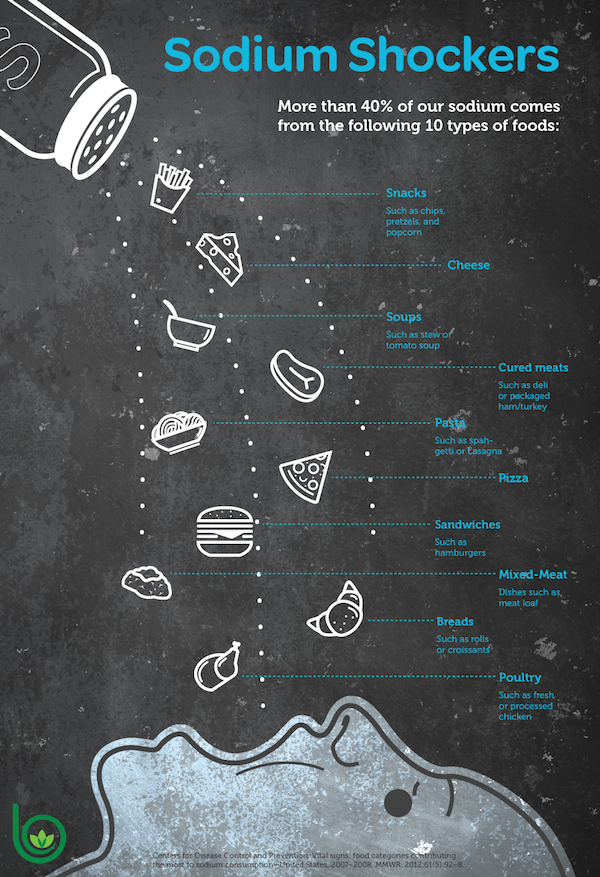
A major contributor to this increase in salt consumption is not due to sprinkling salt from the shaker (obviously this adds to it), but studies show that most salt from our diet is from processed and manufactured foods.<span id="more-6928"></span> Examples include tomato sauce, soups, condiments, canned foods, prepared mixes, etc. Other contributors of high-sodium <a title="chemical foods" href="http://www.dietsinreview.com/diet_column/10/8-chemical-food-additives-you-should-avoid"  target="_self">chemicals in our diet</a> are baking soda, baking powder, and MSG (others on food labels/ingredient list include disodium phosphate, sodium alginate, sodium benzoate, etc.).</p>
<p>The <a title="american heart association diet" href="http://www.dietsinreview.com/diets/AHA_No-Fad_Diet/"  target="_self">American Heart Association</a> (AHA) recommends healthy American adults should eat less than 2,300 milligrams of sodium a day. This is about 1 teaspoon of sodium chloride (table salt). To illustrate, the following are sources of sodium in the diet.</p>
<ul>
<li> 1/4 teaspoon salt = 575 mg sodium</li>
<li>1/2 teaspoon salt = 1,150 mg sodium</li>
<li>3/4 teaspoon salt = 1,725 mg sodium</li>
<li>1 teaspoon salt = 2,300 mg sodium</li>
<li>1 teaspoon baking soda = 1000 mg sodium</li>
</ul>
<p><strong>The good news.</strong><br />
The good news is we can break this salt consuming trend.  You need to do two things: 1) severely reduce the amount of processed foods you consume and 2) retrain your taste buds so you become more salt sensitive. Remember, you don’t need to go crazy and completely cut salt from your diet. Work on making small, gradual reductions, which will be virtually unrecognizable and can help you accomplish your salt-reducing goal with no change in the tastefulness of foods.<a href="http://www.dietsinreview.com/http://www.dietsinreview.com/topics/vegetarian/" ><img class="alignright size-medium wp-image-4897" title="healthy woman chopping vegetables" src="http://www.dietsinreview.com/diet_column/wp-content/uploads/2009/01/healthy-woman-chopping-vegetables-300x223.jpg" alt="chopping vegetables" width="300" height="223" /></a></p>
<p><strong>How do I reduce salt in my diet?</strong><br />
The AHA recommends the following:</p>
<ul>
<li>Choose fresh, frozen or canned food items without added salts.</li>
<li>Select unsalted nuts or seeds, dried beans, peas and lentils.</li>
<li>Limit the amount of salty snacks you eat, like chips and pretzels.</li>
<li>Avoid adding salt and canned vegetables to homemade dishes.</li>
<li>Select unsalted, fat-free broths, bouillons or soups.</li>
<li>Select fat-free or low-fat milk, low-sodium, low-fat cheeses, as well as low-fat yogurt.</li>
<li>Specify what you want and how you want it prepared when dining out. Ask for your dish to be prepared without salt.</li>
<li>Use spices and herbs to enhance the taste of your food.</li>
</ul>
<p>(Via <a title="webmd" href="http://www.webmd.com/heart/news/20090326/too-much-salt-hurting-two-thirds-of-americans" onclick="javascript:pageTracker._trackPageview('/outbound/article/www.webmd.com');" target="_self">WebMD</a>)</p>
<p>Post from: <a href="http://www.dietsinreview.com/diet_column" >Diets in Review Blog</a></p>
<p><a href="http://www.dietsinreview.com/diet_column/03/70-of-us-adults-eat-twice-as-much-salt-that-they-need/" >Majority of Adults Eat Twice the Salt They Need</a></p>
]]></content:encoded>
			<wfw:commentRss>http://www.dietsinreview.com/diet_column/03/70-of-us-adults-eat-twice-as-much-salt-that-they-need/feed/</wfw:commentRss>
		<slash:comments>0</slash:comments>
		</item>
		<item>
		<title>Can Salt Make You Happy?</title>
		<link>http://www.dietsinreview.com/diet_column/03/can-salt-make-you-happy/</link>
		<comments>http://www.dietsinreview.com/diet_column/03/can-salt-make-you-happy/#comments</comments>
		<pubDate>Mon, 23 Mar 2009 13:00:11 +0000</pubDate>
		<dc:creator>Jason</dc:creator>
				<category><![CDATA[Health News]]></category>
		<category><![CDATA[depression]]></category>
		<category><![CDATA[hypertension]]></category>
		<category><![CDATA[research studies]]></category>
		<category><![CDATA[salt]]></category>
		<category><![CDATA[sodium]]></category>

		<guid isPermaLink="false">http://www.dietsinreview.com/diet_column/?p=6646</guid>
		<description><![CDATA[There&#8217;s some good news about a food that&#8217;s long been chastised. University of Iowa researchers say that salt may act as a natural anti-depressant. This from the condiment that&#8217;s been blamed for hypertension. Go figure.
Tests on rats found that when there was a salt deficiency, they shied away from activities they normally enjoyed.
&#8220;Things that normally [...]]]></description>
			<content:encoded><![CDATA[<p>There&#8217;s some good news about a food that&#8217;s long been chastised. University of Iowa researchers say that <a title="salt" href="http://www.dietsinreview.com/diet_column/01/3-simple-ways-to-reduce-salt-in-your-diet/"  target="_self">salt</a> may act as a natural anti-depressant. This from the condiment that&#8217;s been blamed for hypertension. Go figure.</p>
<p>Tests on rats found that when there was a salt deficiency, they shied away from activities they normally enjoyed.<a href="http://www.dietsinreview.com/diets/Low-Sodium-Diet/" ><img class="alignright size-full wp-image-6650" src="http://www.dietsinreview.com/diet_column/wp-content/uploads/2009/03/salt-shaker.jpg" alt="salt" width="278" height="185" /></a></p>
<p>&#8220;Things that normally would be pleasurable for rats didn&#8217;t elicit the same degree of relish which leads us to believe that a salt deficit and the craving associated with it can induce one of the key symptoms associated with depression,&#8221; says psychologist Kim Johnson.<span id="more-6646"></span></p>
<p>Of course, too much salt can lead to health problems like <a title="hypertension diet" href="http://www.dietsinreview.com/diets/DASH_Diet/"  target="_self">hypertension</a>. And oh, there are signs that it&#8217;s addictive as well. I don&#8217;t need a study for that, I know from personal experience. We all know the sentiment of &#8220;craving something salty.&#8221;</p>
<p>A spokesman for Consensus Action on Salt and Health (CASH), which campaigns to raise awareness about the health risks of eating too much salt, says &#8220;our bodies need a very small amount of salt to function, but nothing like the quantities that most of us eat. This research may help us to understand why some people still eat too much salt, even though they know it&#8217;s bad for them.&#8221;</p>
<p>&#8220;I personally have never felt depressed by not eating too much salt: I think it would be far more depressing to have a heart attack or stroke that could have been avoided by not eating so much salt.&#8221;</p>
<p>If you don&#8217;t have any health issues, you probably don&#8217;t have to worry too much about your <a title="low sodium diet" href="http://www.dietsinreview.com/diets/Low-Sodium-Diet/"  target="_self">sodium intake</a>, according to the Harvard Medical school website. But for those who need to watch their intake, you should have no more than 2,300-2,400 mg per day.</p>
<p>(via: <a title="Salt" href="http://news.bbc.co.uk/2/hi/health/7938932.stm" onclick="javascript:pageTracker._trackPageview('/outbound/article/news.bbc.co.uk');" target="_blank">BBC</a>)</p>
<p>Post from: <a href="http://www.dietsinreview.com/diet_column" >Diets in Review Blog</a></p>
<p><a href="http://www.dietsinreview.com/diet_column/03/can-salt-make-you-happy/" >Can Salt Make You Happy?</a></p>
]]></content:encoded>
			<wfw:commentRss>http://www.dietsinreview.com/diet_column/03/can-salt-make-you-happy/feed/</wfw:commentRss>
		<slash:comments>2</slash:comments>
		</item>
		<item>
		<title>3 Simple Ways to Reduce Salt in Your Diet</title>
		<link>http://www.dietsinreview.com/diet_column/01/3-simple-ways-to-reduce-salt-in-your-diet/</link>
		<comments>http://www.dietsinreview.com/diet_column/01/3-simple-ways-to-reduce-salt-in-your-diet/#comments</comments>
		<pubDate>Fri, 30 Jan 2009 16:00:09 +0000</pubDate>
		<dc:creator>Brandi</dc:creator>
				<category><![CDATA[Health News]]></category>
		<category><![CDATA[heart disease]]></category>
		<category><![CDATA[msg]]></category>
		<category><![CDATA[salt]]></category>
		<category><![CDATA[sodium]]></category>

		<guid isPermaLink="false">http://www.dietsinreview.com/diet_column/?p=5113</guid>
		<description><![CDATA[The average person is supposed to consume no more than 2300mg of salt/sodium per day (or 1 tsp.). For those with high blood pressure, it&#8217;s about 1500mg. Most of us are consuming two-to-three times this amount each day. You&#8217;ll be hard-pressed to find a packaged or processed food, or a restaurant menu item that is [...]]]></description>
			<content:encoded><![CDATA[<p><a href="http://www.dietsinreview.com/diet_column/tag/salt/" ><img class="alignright size-medium wp-image-5114" title="salt" src="http://www.dietsinreview.com/diet_column/wp-content/uploads/2009/01/salt-300x274.jpg" alt="" width="300" height="274" /></a>The average person is supposed to consume no more than 2300mg of salt/sodium per day (or 1 tsp.). For those with high blood pressure, it&#8217;s about 1500mg. Most of us are consuming two-to-three times this amount each day. You&#8217;ll be hard-pressed to find a packaged or <a title="food additives" href="http://www.dietsinreview.com/diet_column/10/8-chemical-food-additives-you-should-avoid"  target="_self">processed food</a>, or a restaurant menu item that is low in salt. Food manufacturers are making an effort to include more reduced-sodium items, but even those still have astonishing quanities.</p>
<p>Avoid the risk of stroke and heart disease by following these simple <a title="sodium" href="http://www.webmd.com/diet/low-sodium-recipe-cooking-tips" onclick="javascript:pageTracker._trackPageview('/outbound/article/www.webmd.com');" target="_blank">tips</a> for reducing salt in a <a title="low sodium diet" href="http://www.dietsinreview.com/diets/Low-Sodium-Diet/"  target="_blank">low-sodium diet</a>:</p>
<ol>
<li><strong>Eat Fresh Foods</strong>. Cook your own meals, use fresh produce, use fresh meats and seafood, and rinse canned foods before serving.</li>
<li><strong>Read Labels</strong>. Carefully read labels and buy items that indicate no- or low-sodium. Beware of sodium agents like monosodium glutamate (MSG) and baking soda or powder.</li>
<li><strong>Skip the Instructions</strong>. Replace salt in recipes with any other spice or herb.</li>
</ol>
<p>Post from: <a href="http://www.dietsinreview.com/diet_column" >Diets in Review Blog</a></p>
<p><a href="http://www.dietsinreview.com/diet_column/01/3-simple-ways-to-reduce-salt-in-your-diet/" >3 Simple Ways to Reduce Salt in Your Diet</a></p>
]]></content:encoded>
			<wfw:commentRss>http://www.dietsinreview.com/diet_column/01/3-simple-ways-to-reduce-salt-in-your-diet/feed/</wfw:commentRss>
		<slash:comments>3</slash:comments>
		</item>
		<item>
		<title>8 Chemical Food Additives You Should Avoid</title>
		<link>http://www.dietsinreview.com/diet_column/10/8-chemical-food-additives-you-should-avoid/</link>
		<comments>http://www.dietsinreview.com/diet_column/10/8-chemical-food-additives-you-should-avoid/#comments</comments>
		<pubDate>Thu, 02 Oct 2008 15:00:46 +0000</pubDate>
		<dc:creator>Brandi</dc:creator>
				<category><![CDATA[Nutrition & Health]]></category>
		<category><![CDATA[food additives]]></category>
		<category><![CDATA[restaurants]]></category>
		<category><![CDATA[salt]]></category>

		<guid isPermaLink="false">http://www.dietsinreview.com/diet_column/10/8-chemical-food-additives-you-should-avoid/</guid>
		<description><![CDATA[We all know our food ingredient labels are riddled with words that require an advanced degree to understand. Most of us bypass reading them because it&#8217;s easier. However, buried in those multi-syllabic words are chemical additives that can have an adverse effect on our health and how are bodies absorb nutrients. These chemical ingredients increase [...]]]></description>
			<content:encoded><![CDATA[<p>We all know our <a title="food labels" href="http://www.dietsinreview.com/diet_column/07/reading-a-food-label-101/"  target="_blank">food ingredient labels</a> are riddled with words that require an advanced degree to understand. Most of us bypass reading them because it&#8217;s easier. However, buried in those multi-syllabic words are chemical additives that can have an adverse effect on our health and how are bodies absorb nutrients. These <a title="chemical foods" href="http://www.cspinet.org/reports/chemcuisine.htm#quorn" onclick="javascript:pageTracker._trackPageview('/outbound/article/www.cspinet.org');" target="_blank">chemical ingredients</a> increase a food&#8217;s shelf life, enhance their flavor and color, and make them all-around more appealing to consumers. Packaged food manufacturers and fast food or dine-in restaurants use them (consider this <a title="mcdonalds hamburger" href="http://bestwellnessconsultant.com/2008/09/23/1996-mcdonalds-hamburger-karen-hanrahan-best-of-mother-earth.aspx?results=1#SurveyResultsChart" onclick="javascript:pageTracker._trackPageview('/outbound/article/bestwellnessconsultant.com');" target="_blank">12-year old hamburger from McDonald&#8217;s</a> that has not varied in appearance at all). Use this list as a guide of eight chemical additives you should avoid.</p>
<p>Remember, as our pal Chef Rocco from Biggest Loser advises- shop the perimeter of your grocery store because that&#8217;s where all the unprocessed foods are stocked. Eat a diet rich in fresh produce, whole grains, lean proteins and fish and low-fat dairy and your body will thank you.</p>
<p><strong>1. Trans Fat</strong></p>
<p><img title="chicken strips" src="http://www.dietsinreview.com/diet_column/wp-content/uploads/2008/09/chicken-strips.gif" alt="chicken strips" width="100" height="100" align="left" />This additive has garnered much attention recently, and popular trainer Jillian Michaels noted that its the one thing she&#8217;d completely remove from grocery stores if she could. Noted on food ingredient labels as &#8220;Partially Hydrogenated Oil or Vegetable Oil,&#8221; consuming this can be detrimental to your health by promoting poor cardiovascular health and premature heart attacks. Read your labels closely, a food containing &lt;.5g of trans fat per serving is permitted to list zero grams on its label (like <a title="special k challenge" href="http://www.dietsinreview.com/diet_column/05/special-k-challengers-watch-out-for-trans-fat/"  target="_blank">Special K Bars</a>).</p>
<p>Culprits:<em> Fried Food, Restaurant Food, Microwave Popcorn, Margarine, Crackers, Chips, Packaged Cookies and Cakes</em></p>
<p><strong>2. Salt/Sodium<br />
</strong></p>
<p><img title="salt" src="http://www.dietsinreview.com/diet_column/wp-content/uploads/2008/09/salt.gif" alt="salt" width="100" height="100" align="left" />It&#8217;s possibly one of the most dangerous additives in our food supply. Everyone from food manufacturers, restaurant chefs and dear old mom use it in nearly everything we eat and drink. Whether used as a preservative or to enhance or better the flavor, foods high in salt/sodium pose a great risk to our cardiovascular health. The recommended daily allowance for sodium is 2,400 mg, or 1 tsp. of table salt, per day. Fast food meals like McDonald&#8217;s Grilled Chicken Ranch BLT combo (~1785 mg Sodium), can contain close to, if not more, than an entire day&#8217;s worth of sodium.</p>
<p>Culprits: <em>Fast Food, Deli Meats, Canned Goods, Crackers, Chips, Processed/Packaged Foods</em><span id="more-1437"></span></p>
<p><strong>3. Artificial Coloring</strong></p>
<p><img title="food coloring" src="http://www.dietsinreview.com/diet_column/wp-content/uploads/2008/09/food-coloring.gif" alt="food coloring" width="100" height="100" align="left" />Typically found in foods that are already not providing any nutrition, it&#8217;s best to just stay away from anything with artificial colors. The dyes are just a chemical- so they contain no vitamins, minerals or other nutrients. Read food labels closely, and be especially cautious of those listing Blue 1, Blue 2, Green 3, Red 3, Yellow 6- all of which have been linked with various tumors and cancers.</p>
<p>Culprits: <em>Soda, Candy, Juice, Packaged Baked Goods, Frosting, Gelatin, Fruit Cocktail, Sausage</em></p>
<p><strong>4. Saccharin</strong></p>
<p><img title="sweet n low" src="http://www.dietsinreview.com/diet_column/wp-content/uploads/2008/09/sweet-n-low.gif" alt="sweet n low" width="100" height="100" align="left" />Much sweeter than sugar, this artificial sweetener made it possible for dieters to enjoy the foods they love. In recent years, <a title="aspartame" href="http://www.dietsinreview.com/diet_column/09/aspartame-101/"  target="_blank">aspartame</a> has taken its place and hasn&#8217;t been looked at as negatively. Saccharin has been considered for ban by the FDA, and is linked with multiple types of cancers in many studies. It&#8217;s a man-made chemical and again, promotes nothing nutritious within your body. It should be avoided wherever possible.</p>
<p>Culprit: <em>Diet Soda, Sweetener Packets, Sugar-Free Food Products</em></p>
<p><strong>5. Diacetyl</strong></p>
<p><img title="popcorn " src="http://www.dietsinreview.com/diet_column/wp-content/uploads/2008/09/popcorn.gif" alt="popcorn " width="100" height="100" align="left" />That buttery flavor you love can usually be attibuted to this chemical ingredient. In 2007 it caught much publicity for being the responsible party behind &#8220;<a title="popcorn lung" href="http://en.wikipedia.org/wiki/Popcorn_lung" onclick="javascript:pageTracker._trackPageview('/outbound/article/en.wikipedia.org');" target="_blank">popcorn lung</a>,&#8221; causing lung disease in the workers at microwave popcorn factories. That publicity fortunately caused it to be removed from most foods, but still worth examining your food labels to see if its lurking.</p>
<p>Culprit: <em>Microwave Popcorn, Butter-Flavored Anything</em></p>
<p><strong>6. Olestra</strong></p>
<p><img title="pringles" src="http://www.dietsinreview.com/diet_column/wp-content/uploads/2008/09/pringles.gif" alt="pringles" width="100" height="100" align="left" />Proctor &amp; Gamble went out and created its own fat, and its brand name is Olean. When first created, it was promoted as not only being a fat you could eat, but a fat that would help you lose weight. It is added to typically greasy junk food snacks so that dieters can enjoy them, too. Olestra was quickly found to cause severe gastrointestinal and digestive issues because it is indigestible. It also inhibits the body&#8217;s ability to absorb nutrients like beta-carotene and lycopene found in fruits and vegetables.</p>
<p>Culprit: <em>Pringles Light, Lay&#8217;s Light</em></p>
<p><strong>7. Sodium Nitrite or Nitrate</strong></p>
<p><img title="hotdog" src="http://www.dietsinreview.com/diet_column/wp-content/uploads/2008/09/hotdog.gif" alt="hotdog" width="100" height="100" align="left" />You might have heard people say they avoid nitrates, and this is what they&#8217;re talking about. This chemical additive gives &#8220;cured meats&#8221; that salty flavor, and maintain their reddish tint. As an example, your hot dogs and bacon would be a grey color without it. Manufacturers say its use is important to prevent bacteria growth, critics suggest modern refrigeration does the same thing. This additive has been linked with cancers in children and adults.</p>
<p>Culprits: <em>Ham, Hotdogs, Bacon, Canned Meats/Fish, Corned Beef</em></p>
<p><strong>8. Potassium Bromate</strong></p>
<p><img title="white bread" src="http://www.dietsinreview.com/diet_column/wp-content/uploads/2008/09/white-bread.gif" alt="white bread" width="100" height="100" align="left" />It is likely you won&#8217;t find this additive in your bread goods, but be sure to glance at the label anyway. The U.S. is one of only two countries in the world who have not banned its use (Japan being the other). Bromate can be used to give bread more volume and a better structure. It has been linked to causing cancer in animal studies.</p>
<p>Culprits: <em>White Flour Bread/Grain Products</em></p>
<p>Post from: <a href="http://www.dietsinreview.com/diet_column" >Diets in Review Blog</a></p>
<p><a href="http://www.dietsinreview.com/diet_column/10/8-chemical-food-additives-you-should-avoid/" >8 Chemical Food Additives You Should Avoid</a></p>
]]></content:encoded>
			<wfw:commentRss>http://www.dietsinreview.com/diet_column/10/8-chemical-food-additives-you-should-avoid/feed/</wfw:commentRss>
		<slash:comments>21</slash:comments>
		</item>
		<item>
		<title>20 Saltiest Foods in American Restaurants</title>
		<link>http://www.dietsinreview.com/diet_column/07/20-saltiest-foods-in-american-restaurants/</link>
		<comments>http://www.dietsinreview.com/diet_column/07/20-saltiest-foods-in-american-restaurants/#comments</comments>
		<pubDate>Thu, 31 Jul 2008 19:18:00 +0000</pubDate>
		<dc:creator>Kinsey</dc:creator>
				<category><![CDATA[Health News]]></category>
		<category><![CDATA[Nutrition & Health]]></category>
		<category><![CDATA[restaurants]]></category>
		<category><![CDATA[salt]]></category>

		<guid isPermaLink="false">http://www.dietsinreview.com/diet_column/07/20-saltiest-foods-in-american-restaurants/</guid>
		<description><![CDATA[How often do you see or how often do you grab that salt shaker and start pouring salt all over your food as soon as the plate is set in front of you?  Sodium intake in our nation is extremely too high.  Did you know that the recommended amount of sodium intake per day is [...]]]></description>
			<content:encoded><![CDATA[<p>How often do you see or how often do you grab that salt shaker and start pouring salt all over your food as soon as the plate is set in front of you?  Sodium intake in our nation is extremely too high.  Did you know that the recommended amount of sodium intake per day is less then 2,300 milligrams, which only equals 1 teaspoon? (*Note. Daily Value used on food labels is based off 2,400 milligrams).<img title="salt" src="http://www.dietsinreview.com/diet_column/wp-content/uploads/2008/07/salt1.jpg" alt="salt" width="150" height="279" align="left" /></p>
<p>Sodium plays a vital role in our bodies by helping maintain acid-base balance and it is essential to nerve impulse transmission and muscle contraction.  However, too much sodium makes our bodies hold on to fluid and to pump the added fluid, the heart has to work harder which over years of doing this puts an extreme strain on our heart. Also, too much salt can worsen symptoms like swelling and shortness of breath and cause weight gain.  A diet high in salt has been linked to very serious health conditions including high blood pressure, hypertension, and heart disease.</p>
<p>The Today Show posted an article with the 20 Saltiest Foods in America.  They compiled a top 20 list of foods (or dishes) found in restaurants across our nation.  Their list is posted below.</p>
<p>20. Saltiest Side Dish<br />
Denny&#8217;s Honey Smoked Ham, grilled slice. 1,700 mg sodium, 85 calories</p>
<p>19. Saltiest Dessert<br />
Atlanta Bread Company Raspberry Scone. 1,750 mg sodium, 360 calories</p>
<p>18. Saltiest Soup<br />
Baja Fresh Chicken Tortilla Soup. 2,760 mg sodium, 320 calories<span id="more-852"></span></p>
<p>17. Saltiest Burger<br />
Hardee&#8217;s 2/3 lb Monster Thickburger. 2,770 mg sodium, 1,420 calories, 108 g fat</p>
<p>16. Saltiest &#8220;Healthy&#8221; Food<br />
Chili&#8217;s Guiltless Grill Chicken Platter. 2,780 mg sodium, 590 calories, 85 g carbs</p>
<p>15. Saltiest Pasta<br />
Fazoli&#8217;s Rigatoni Romano. 3,180 mg sodium, 1,090 calories, 54 g fat, 101 g carbs</p>
<p>14. Saltiest Chinese Entrée<br />
P.F. Chang&#8217;s Beef with Broccoli. 3,752 mg sodium, 1,120 calories, 65 g fat</p>
<p>13. Saltiest Breakfast<br />
Arby&#8217;s Sausage Gravy Biscuit. 3,754 mg sodium, 961 calories</p>
<p>12. Saltiest Beef Entrée<br />
Bob Evans Steak Tips and Noodles.4,131 mg sodium, 822 calories, 43 g fat</p>
<p>11. Saltiest Frozen Dinner<br />
Swanson Hungry-Man XXL Roasted Carved Turkey.4,480 mg sodium, 1,360 calories, 70 g fat</p>
<p>10. Saltiest Bread<br />
Dunkin&#8217; Donuts Salt Bagel. 4,520 mg sodium, 320 calories, 62 g carbs</p>
<p>9. Saltiest Sandwich<br />
Quiznos Turkey Bacon Guacamole Large Sub with Cheese and Reduced-Fat Ranch Dressing. 4,670 mg sodium, 1,120 calories, 49 g fat, 116 g carbs</p>
<p>8. Saltiest Pizza<br />
Pizza Hut Meat Lover&#8217;s Stuffed Crust Pizza (3 slices of the 14&#8221; large). 5,070 mg sodium, 1,560 calories, 87 g fat, 114 g carbs</p>
<p>7. Saltiest Comfort Food<br />
Denny&#8217;s Meat Loaf Dinner (with Mashed Potatoes and Corn). 5,080 mg sodium, 1,210 calories, 69 g fat, 97 g carbs</p>
<p>6. Saltiest Salad<br />
Romano&#8217;s Macaroni Grill Chicken Florentine. 5,460 mg sodium, 840 calories, 53 g fat</p>
<p>5. Saltiest Mexican Entrée<br />
Chili&#8217;s Buffalo Chicken Fajitas. 5,690 mg sodium, 1,730 calories, 107 g fat, 143 g carbs</p>
<p>4. Saltiest Kids&#8217; Meal<br />
Cosi Kid&#8217;s Pepperoni Pizza. 6,405 mg sodium, 1,901 calories, 93 g fat, 190 g carbs</p>
<p>3. Saltiest Seafood Entrée<br />
Romano&#8217;s Macaroni Grill Grilled Teriyaki Salmon. 6,590 mg sodium, 1,230 calories, 74 g fat, 79 g carbs</p>
<p>2. Saltiest Appetizer<br />
Papa John&#8217;s Cheesesticks with Buffalo Sauce. 6,700 mg sodium, 2,605 calories, 113 g fat, 296 g carbs</p>
<p>1. The Saltiest Dish in America<br />
Romano&#8217;s Macaroni Grill Chicken Portobello. 7,300 mg sodium, 1,020 calories, 66 g fat</p>
<p><img title="macaroni gril" src="http://www.dietsinreview.com/diet_column/wp-content/uploads/2008/07/macaroni-grill-chicken-portobello.jpg" alt="macaroni gril" width="236" height="197" align="middle" /></p>
<p>Most Americans consume way more sodium than what is recommended.  To cut down on your sodium intake try doing the following:</p>
<ul>
<li>Limit the amount of times you eat out</li>
<li>Select fresh, unprocessed foods</li>
<li>Prepare foods with sodium-free spices (basil, bay leaves, curry, garlic, ginger, mint, oregano, pepper, rosemary, and thyme)</li>
<li>Add little or no salt at the table; take the salt shaker off of the table!</li>
<li>Taste your food first and see if you actually need to add something else for flavor… you may choose another spice or seasoning instead of salt.<br />
<a title="food labels" href="http://www.dietsinreview.com/diet_column/07/reading-a-food-label-101/"  target="_blank"> </a></li>
<li><a title="food labels" href="http://www.dietsinreview.com/diet_column/07/reading-a-food-label-101/"  target="_blank">Read food labels</a></li>
<li>Select low-salt or salt-free products when available</li>
</ul>
<p>Post from: <a href="http://www.dietsinreview.com/diet_column" >Diets in Review Blog</a></p>
<p><a href="http://www.dietsinreview.com/diet_column/07/20-saltiest-foods-in-american-restaurants/" >20 Saltiest Foods in American Restaurants</a></p>
]]></content:encoded>
			<wfw:commentRss>http://www.dietsinreview.com/diet_column/07/20-saltiest-foods-in-american-restaurants/feed/</wfw:commentRss>
		<slash:comments>2</slash:comments>
		</item>
	</channel>
</rss>