Eatin’ good in the neighborhood just got a lot easier to do if you’re on Weight Watchers. Applebee’s, who has worked in partnership with the weight loss brand since 2004, just announced its extension of the relationship. To celebrate, they’re unveiling three new menu items endorsed by Weight Watchers.
Diners will find a new steak, shrimp, and chicken entree upon their next visit to Applebee’s, and each meal boasts 12 PointsPlus or less. These meals also appear on their Under 550 Calories Menu.
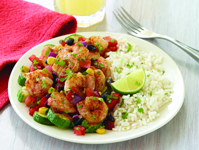 Grilled Jalapeno-Lime Shrimp offers a generous serving of grilled chipotle lime shrimp and black bean corn salsa flavored with lime juice and cilantro. This meal comes with mixed grilled zucchini, marinated tomatoes, onions and red peppers with steamed white rice. This meal has 8 Weight Watchers PointsPlus.
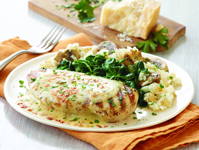 Creamy Parmesan Chicken
 is a juicy grilled chicken breast with an au gratin Parmesan sauce served with sides of steamed spinach and mushroom rice pilaf. This meal has 12 Weight Watchers PointsPlus.
 Cabernet Mushroom Sirloin is a cut of Applebee’s seven-ounce grilled House Sirloin with sautéed Portobello mushrooms and onions in a Napa Valley Cabernet sauce. Sides include steamed herbed potatoes and garlic broccoli. This meal has 12 Weight Watchers PointsPlus
While Weight Watchers members can use the app, member site, or materials from meetings to learn the PointsPlus values in countless restaurant meals, Applebee’s is the only restaurant where customers will find approved meals right on their menu. With lean cuts of meat, vegetable sides, and flavorful ingredients, diet or not this would be a smart menu to order from. We’re especially glad to see cooking preparations like steaming and grilling used.
We’d still love to see a few minor alterations to these menu items, and you should at least try to ask for them when you order. This will reduce the calories further, or the PointsPlus values, or simply add healthier items to your meal. You can make these requests to any menu item at any restaurant.
1. No white rice. Ask your server if you can swap the white rice (read: void of nutritional value) for a serving of brown or wild rice.
2. Skip the oils. Ask your server if your vegetable sides can be steamed, and if the preparation involves oil ask them to leave it off.
3. Sauces on the side. Ask your server if the au gratin Parmesan sauce can be served on the side instead smothered on top of the chicken breast.
All in all, it looks like Applebee’s and Weight Watchers have really worked to provide meals that diners don’t really have to think twice about. If you’re adding spirits to your meal, consider one of their 100-calorie SkinnyBee margaritas (just skip dessert if you do!).
Posted on February 21, 2026 by Natalie K
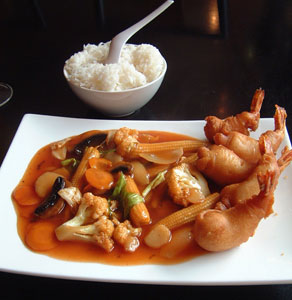 Researchers found that one third of customers opt for half portions of rice or noodles when given the option, even when the cost in not significantly less. Cutting down the serving size of starchy sides like these can represent a major calories savings, even when the entree remained the same.
The research was conduced at a popular Chinese restaurant not far from Duke University, typically frequented by students, staff and visitors to the campus hospital. The standard serving of rice or noodles is 10 ounces for 400 calories. Patrons where asked, “Would you like a half-order to save 200 calories?” Depending on the day, 14 to 33 percent of patrons said yes. Moreover, those who ordered the smaller side dishes also ate less, the researchers determined.
The researchers also tested to see if adding calorie counts to menus and offering a small discount for smaller servings would motivate patrons to eat less, however these changes did not affect ordering habits. We’re more likely respond to visual cues to tell us how much to eat, rather than slowing down and waiting for our bodies to trigger feelings of fullness.
(more…)
Posted on February 14, 2026 by Health Buzz
Even with road closures, more time spent in traffic, and parking rates unusual for the Circle City, it is hard to find anyone complaining in Indianapolis. We are all excited and proud to be a Super City. Despite the spike in business and catering orders that restaurant owners were already seeing the two weeks before the Super Bowl, I was able to interview a few local business owners to hear the truth about how they are or are not doing things differently for the Super Bowl.
One major rumor is that restaurants are jacking up prices to gouge out of towners this weekend, but Monon Food Company in Broad Ripple and Thr3e Wise Men Brewing Company/Scotty’s Brewhouse assured me that they are not. The Scratch Truck food truck may have to cover additional expenses during the week leading up to the Super Bowl because they will be hiring additional staff and renting out extra space for all the food preparation that they need to do, which they anticipate being up to six times what they do during a normal week. While they may not be increasing prices, all the restaurants I spoke to assured me that they will be bringing in additional staff to ensure the best service possible.
Since Indianapolis is host to the “Greatest Spectacle in Racing” – the Indianapolis 500 – every year, which sells three times the tickets that the Super Bowl will, as well as other major racing events that bring in fans from around the world, we are no stranger to crowd management. However, all of the restaurant representatives agreed that the Super Bowl is different. Tim of the Monon Food Company explained that the “press experience around [Super Bowl XLVI] far exceeds other events, so there is more excitement and more spectators who are coming to town just to party,” even if they are not going to the big game on Sunday. (more…)
Posted on February 2, 2026 by Brooke Randolph
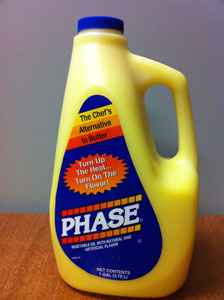 Phase oil is probably not something you’ve ever heard of, or even considered cooking with, but you’ve probably eaten it. It’s a common butter substitute that is used in many restaurants and hotels, primarily for frying but can also be added to baked goods and other recipes. Created by Ventura Foods, Phase Liquid Butter Alternative contains a number of very unhealthy ingredients, outlined below, which is why you should be concerned about eating it.
- Liquid and hydrogenated soybean oil: Phase contains 18 percent saturated fat and 1.5 grams of trans fat per tablespoon.
- TBHQ: Tertiary butylhydroquinone, an antioxidant commonly added to fry oils to retard spoilage and make them better suited for heavy-duty use.
- Soy Lecithin: Also found in baked goods, margarine, chocolate and ice cream, this common constituent of animal and plant tissues, lecithin is a source of the nutrient choline. It keeps oil and water from separating out, retards rancidity, reduces spattering in a frying pan, and leads to fluffier cakes. Major natural sources are egg yolk and soybeans.
- Dimethylpolysiloxane: A polymer composed of alternating silicon and oxygen atoms and having two methyl groups attached; it can, depending on molecular weight, have properties ranging from oils to plastics.
(more…)
Posted on January 24, 2026 by Margaret
 We’ve all been there – the kids are in the backseat, everyone is hungry, and you’ve got to be at a soccer game in twenty minutes. You have no choice; you’ll have to stop at a fast food restaurant and pick up dinner. Your fast food options historically have left much to be desired, but one company has listened to consumers and is working to change that.
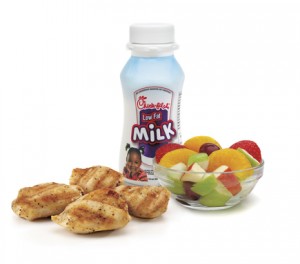
Today, Chick-Fil-A unveiled a revamped kid’s meal. Focused on their newest entree, grilled chicken nuggets, this kid’s meal clocks in with fewer calories and lower sodium levels. This new kid’s meal is predicted to be one of the most nutritious fast food kid’s meals in the country. Chick-Fil-A is already known for having some of the healthier food choices at a fast food restauran, but they are by no means a saintly choice, boasting some of the worst choices as well.
Compared to a typical hamburger fast food meal, the four count grilled nugget meal (with a fruit cup and a low fat milk) contains 60% less calories and an estimated 85% less fat. In addition to the fruit cup side offering, Chick-Fil-A is adding Buddy Fruits Pure Blended Fruit To Go Applesauce into the options.
(more…)
Posted on January 9, 2026 by Carmen
 This week, Columbus-based restaurant and food products company Bob Evans, which runs 564 restaurants in 18 states announced that it is testing home delivery this holiday season and into 2026. The test menu will offer five frozen choices:
- Homestyle breakfast, including bacon, sausage, hash browns and biscuits, serving between 12 and 15 for $77.95.
- Farm-grill favorites with bratwurst and Italian sausage, serving between 12 and 15 for $95.
- Savory dinner with a 3.5- to 4.5-pound turkey breast, meant for four to eight diners at $95.
- Ham feast with a 8.5- to 9.5-pound spiral-sliced ham for between 12 and 15 at the table for $170.
- Turkey feast with a 10- to 12-pound smoked turkey for 12 to 15 is $170.
If the test menu performs well, the company expects that it could be open to the public in time for Easter 2026. While it is hard to argue with the convenience of direct-delivery service, dietitians and nutrition experts have some concerns about the nutritional quality of the meals.
(more…)
Posted on December 24, 2025 by Maris
 One of the funniest women comics around thinks that her new restaurant is the breath of fresh air the restaurant industry needs.
Ellen DeGeneres and her wife Portia De Rossi have teamed up with Chrissie Hynde of The Pretenders and film producer Steve Bing to open a vegan restaurant. The unnamed eatery will be located on Ventura Boulevard in San Fernando Valley, California. The menu will be designed by Tal Ronnen, who is best known for catering the wedding of DeGeneres and Rossi. Ronnen was also the chef responsible for the food for Oprah’s Vegan Cleanse and cooked the first vegan meal for the U.S. Senate.
Vegans do not ingest any animal products. They avoid all forms of dairy, meat, honey, and eggs, as well as fur, leather, wool, down, and cosmetics or chemical products tested on animals.
(more…)
Posted on November 1, 2025 by Carmen