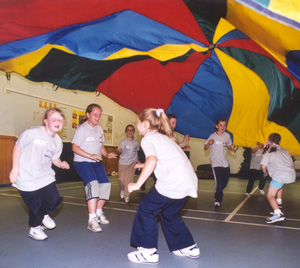
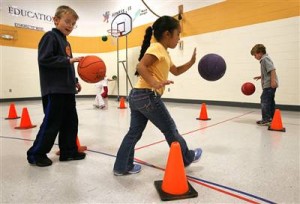
As school budgets continue to shrink, one area we see cut time and time again is physical education. Schools eliminate this vitally important part of a student’s schedule in exchange for more classroom time to prep for tests, reduce the burden of a full-time teacher salary, and maintenance costs for gym and equipment. It’s to the detriment of our students that they lose PE programs. In some schools they’re actually finding new ways to infuse fitness back in to the learning environment, though. 
Yoga has long been celebrated for its extensive list of benefits, which include focus, energy, and overall fitness for even the youngest of practitioners. While not as common as reading or math, yoga is making an appearance in more and more schools, and it’s proving as worthwhile to students as anything they’re learning in a book.
In 2001, The Accelerated School in Los Angeles introduced a pilot program of YogaEd. Lead by Tara Guber, an expert practitioner and teacher with more than 25 years experience, the students followed a secular yoga practice that taught relaxation, stress, self-esteem, as well as posture and body awareness. Two years later, the results of the program were analyzed in a study that deemed the yoga curriculum not only worthwhile for that school, but worthy of introduction in more schools. Today, they tell us they have 900 instructors in the 35 states and Canada.
Victor High School of Victor, New York is one school that has added yoga to its physical education curriculum. For the past seven years yoga has been on the elective schedule for students and it’s always one of the first classes to fill up, according to Shelly Collins, PE Department Chair and High School Physical Educator at Victor High. She told us the course was initially only open to juniors and seniors for the first five years, but it was so well received that they are now in their second year of offering the yoga class to freshmen and sophomores, too.
“We have a strong passion to introduce and teach our students activities that they can use for their lifetime,” said Collins. The staff practiced that passion seven years ago when the school’s director of physical education, Ronald Whitcomb, challenged them to find a fitness class that was popular in the community and bring it back to their students. After meeting with local yoga studio owners, the curriculum was set and the course added.
The Victor High students attend a one-hour beginner level class each week, and many have grown in their aptitude and enjoyment of the practice enough to pursue community yoga classes outside of school. “They are confident that they will be able to understand and participate,” said Collins.
Proven benefits of yoga in schools include improved self-esteem for students, better overall physical health, better grades, lower stress, and improved problem solving capabilities. What parent wouldn’t want that for their child? What teacher wouldn’t also benefit from this in each of her students?
“Yoga is a lifetime activity that our students find enjoyable and challenging,” said Collins. “Many students comment that they are more relaxed and less stressed after having finished one of our yoga classes. The health benefits are something that the students can feel right away, and in this day and age of ‘instant gratification,’ it has immediate results with our students.”
 Unlike a math teacher who can’t so easily transition to teach an English class, yoga can be taught by anyone on staff with the certification. Hundreds of teachers have gained such certifications through Lisa Flynn’s Yoga 4 Classrooms, a program piloted at an elementary school in Maine. After positive feedback and great results, thousands of teachers were inspired to add the practice to their classrooms.
It’s important to note the use of “secular” yoga mentioned in the YogaEd program, as there are continually differing opinions on the religious implications of the practice. “We explain that yoga is not religion, and appeal to school administrators that our curriculum is modeled the same as English or math with lesson plans that meet national PE standards,” Ellen Vittoria of YogaEd told us. In some schools, the word yoga isn’t even used, nor is meditation, and it’s referred to as stretch class or something else generic. Schools avoid anything that may have a religious undertone to prevent backlash from parents. Vittoria explained that all of their course materials use English translations with no mention of Sanskrit or Hindu. Whether yoga is spiritual, religious, or purely physical, the debate exists and should be treaded lightly.
As far as the costs, they can actually be fairly minimal to the school or district. At Victor High, they made an initial investment of mats and blocks and replace as needed. It’s more affordable to have a current staff member, ideally someone from the physical education department, trained and certified than it would be to hire a full-time dedicated yoga instructor. It’s also possible that community members would lead the yoga courses for a free or discounted rate as a way of giving back.
The benefits exist for the students, teachers, and schools when any kind of physical fitness is included in the curriculum. But yoga goes beyond the lessons of sportsmanship and teamwork, it teaches discipline, commitment, and the ability to listen to oneself. “I feel like students get so stressed out these days over good grades, making teams, getting into the right college—it’s high competition. Yoga could be a great outlet for them to feel calm and teach each moment as it comes,” said Kathryn Budig, a renowned yoga expert who is releasing The Big Book of Yoga this fall with Rodale.
Also Read:
Back to School Yoga Relieves the Jitters
5 Ways Teachers Can Improve the Health of Their Classrooms
Sarah Wu’s “Fed Up With Lunch” Outs the Nutritionally-Void School Lunch Program