



Tag Archives: muscles

The Golf Workout

golf workoutWell, it’s definitely summer time and that means golf season is in full affect. Golf originated in Scotland in the 12th century and has been very popular ever since. I strongly believe that golf is a game of mental toughness, natural ability or skill, and a little bit of luck. I play once or twice a year so I am definitely no expert, but I have trained my share of golfers and have had great success with them. (more…)

10 Week Wedding Fitness Plan: Week 8

wedding fitnessLast week we discussed core stability training and the importance of staying hydrated. Over the next few weeks, we are going to discuss the importance of stretching. Today, the topic is focused on self stretching.

Wedding Season Week 8:

“Learn to relax. Your body is precious, as it houses your mind and spirit. Inner peace begins with a relaxed body.” (Norman Vincent Peale)

Tip: Remember to warm-up and cool down before and after your workouts. I understand that it takes time away from the actual workout, but it’s worth it. (more…)

The Tennis Player’s Workout

Tennis is a rather popular summer sport. The game of tennis was founded by a couple of friends back in the 1800s in the United Kingdom. The world’s first tennis club was founded in 1872 in England and the tennis market and popularity has grown ever since.tennis workout

The sport of tennis is not only fun, but it provides several health benefits as well. One of which, according to Dr. Jack Groppel, is that people who play at least three hours of tennis a week cut their chances of death from any cause or health risk in half. I don’t know about you, but I am going to start playing a little more tennis according to that statistic.

Another benefit is that competitive tennis burns more calories than aerobics such as in-line skating or cycling. Lastly, according to Dr. Jim Gavin, tennis outperforms other sports in developing positive personal characteristics such as self-esteem and self-worth. (more…)

Summertime Nutrition Tips

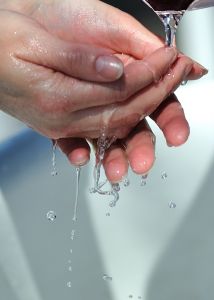
hand washingSummer is here which means there will be plenty of long days spent outside by the beach, lake, or poolside. It’s very important to apply and re-apply plenty of sunblock, but the sun can effect other parts of your body, not just your skin.  Below is a list found on WebMD of sun problems and associated foods that can help your body bounce back from the sun’s powerful rays.

Dry or Damaged Skin

  • Caused by: sweating more in summertime causing your skin to be less supple; chlorine in pool water and saltwater can also dry out your skin; finally the very common sunburn really can dry out your skin. (more…)

Soda May Cause Muscle Paralysis

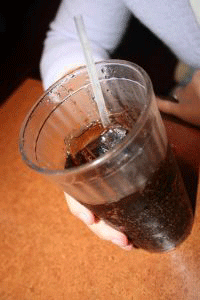
sodaPopeye had spinach to make his muscles pop. Inversely, pop (soda) may actually make our muscles weaker.

Doctors are warning that cola drinks, when consumed in excess, deplete the body of potassium, which can lead to weakness, and much worse – muscle paralysis.

Dr. Moses Elisaf of the University of Ioannina in Greece authored the research paper that’s come to these conclusions. He says that the hypokalaemia (potassium deficiency) can be caused by excessive consumption of glucose, fructose and caffeine, common ingredients in cola drinks. (more…)

Don’t Overlook Obliques to Reduce Love Handles

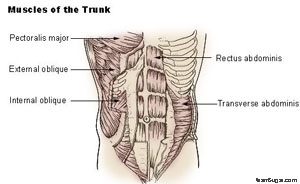
oblique musclesPeople often focus on crunches and sit-ups and forget about the obliques. Crunches and sit-ups work the rectus abdominis while not really isolating the oblique muscles.  The obliques consist of the internal and external obliques and are often referred to as “love handles.” Rotation and lateral flexion of the spine are the main “jobs” or movements of the internal and external obliques. The tranversus abdominis is similar to the obliques, but it is mainly used for posture, balance, and stability.

Twisting and turning the spine is a very sensitive subject, so be very careful while performing these movements. Try not to use too much weight or over rotate because this compromises the spine and could lead to future problems.

Below are a few of the top obliques exercises, and I recommend performing two or three sets of 20 to 30 repetitions. (more…)

How to Train Legs, Part I

steve hansonSteve Hanson has been studying health, fitness, and nutrition since 1996. While he now works as a software engineer and web developer, Steve spent several years as a personal trainer and sport nutritionist in southern NH. Steve runs a blog called Project Swole, where health-minded web surfers can go to learn how to build muscle and lose fat more efficiently. Project Swole is a collection of articles, tips, and personal experiences that anyone can use to become stronger, leaner, and healthier.

The Missing Link

With average gym goers primarily concerned with the development of their upper body, many weight lifters forget or just neglect to train their legs. This becomes a problem with both men and women who are focusing on either building muscle or losing fat.

For men this is a problem because they are often focused on total body functional strength, or aesthetic symmetry and muscle size. For women this is a problem because they often spend too much time on endurance cardio, and end up missing the huge metabolic potential of leg training.

In order to properly integrate leg training into our routine, we need to know why, how, and when to train those wheels. (more…)

Top 10 Core Exercises

What makes up the core? The core is your body’s center of gravity. I have discussed this topic before, but I would like to reiterate the importance of a strong and stable core. The core consists of your abdominal, back, and lower back regions. A strong and stable core is vital for good balance, proper posture, and injury prevention. bikini stomach

  • A strong and stable core will help to stabilize the muscles involved with balance. These muscle regions consist of the hips, hip flexors, abdominals, and other leg muscles as well.
  • Proper posture is important for so many reasons, especially the older you get. Back pain, neck pain, and several other forms of pain can result from poor posture over the years.
  • Injury prevention is another amazing benefit of working the core. Obviously not all injuries can be prevented, but most can be or the severity of the injury can be lessened. (more…)

Train for Success

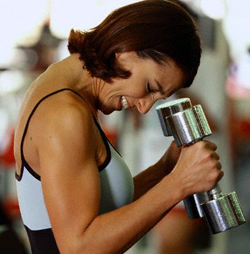
woman lifting weights“How many reps and sets should I do?” As a personal trainer, I hear this question every day and my reply to them is “what is your exercise goal?” There are three main factors that can be changed while lifting weights: weight, the number of repetitions, and the number of sets. For endurance training, I recommend performing several repetitions for two or three sets with a light weight. Fifteen to 20 repetitions is preferable. For strength training, I recommend performing a low number of repetitions for four to five sets with a heavy weight. Five to ten repetitions for strength training is recommended. (more…)

7 Tips for Eliminating Muscle Soreness

Muscle soreness is very common among those of us that workout, especially if you are just beginning the workout process. When you workout, the muscles fibers are being broken down, and this may cause occasional soreness. Thus, the importance of protein, which helps build and repair the broken muscle fibers.

Muscle soreness is caused from either over doing it or never doing it. When the muscles in the body are not used to a certain exercise they may become sore due to the break down of the muscles. If you constantly do the same type of exercise at the same speed or weight, the body is going to adapt to this exercise and the only way to become stronger, faster, or leaner is to change the exercise, and this will more than likely cause muscle soreness. Overdoing the exercise works the same way and if this does happen be sure to note it and back off a little next time. (more…)

Strengthen the Hip with These Six Exercises

Hip pain is a common injury and somewhat confusing because there are so many causes. The hip joint is a synovial joint, which means that it is one of the most movable joints in the body, and its main function is to support the weight of the body in both static (standing) and dynamic (walking) postures. The hip has seven main movements, making it so susceptible to injury. These movements consist of extension and flexion on or from spine or thigh, abduction and adduction of the femur, internal and external rotation of the pelvis, thigh, or spine, and lastly circumduction (circular movement) of the femur or pelvis.

Hip injuries again have several causes, such as: (more…)