Diets in Review - Find the Right Diet for You

Mexico


The Mexican Obesity Crisis is a Growing Health Concern

Mention the country of Mexico, and odds are, the first area of concern that comes to mind is the raging drug war. But Mexicans are facing a new and growing crisis, one that has claimed four times as many lives as the drug wars. You might be surprised, though, especially if you learned that the enemy could very well be a big cup of icy cold Coke.

Obesity was virtually unheard of in Mexico a short 30 years ago, but the changing times have created a different face for the country. A recent study, published by CNN.com, shows that Mexico has surpassed the United States as the country with the highest level of obesity. The Organization for Economic Cooperation and Development reports that 69.5 percent of the Mexican population aged 15 and older is overweight or obese.

The United Kingdom was ranked first for the European countries.

Similar to the U.S., the obesity levels are high in the very youngest of age groups. Four-and-a-half million children between the ages of five and 11 are overweight. The Mexican government has noticed the crisis and in 2010 instituted an initiative urging its citizens to drink more water, increase their fruit and vegetable intake and get more exercise. Many school districts have jumped on board and outlawed junk food inside their doors. The rest of the city has been slow to follow, though, and many parents report that their children can purchase junk food as soon as they leave the school grounds.
Read Full Post >


Mexico Schools Offer Healthier Snack Options to Children

The beginning of the year marked a turning point for schools in Mexico. In order to fight childhood obesity, a soda ban and new food guidelines were put into place. Unfortunately, the new food rules are proving to be too relaxed for the taste of some officials.

Mexico is among the most obese countries in the world and children are far from exempt in these statistics. To put it into numbers, one out of every three children in Mexico is overweight.

Schools in Mexico do not provide school lunches, but food and snacks are sold at recess. After long and painful negotiations with junk food moguls, officials stepped in to mandate what type of foods are allowed to be sold. Although considerable improvements were made, there is still a great need for change. Chips, candy and cookies continue to be readily available for children to purchase during school hours. After school, the situation worsens beyond the reach of the newly-set standards. Vendors eagerly wait outside for the throng of students to come pouring out. Nachos, ice cream and various confections tempt the children after a long day in class.


Read Full Post >


Best Yoga Vacations Around the World

Relaxation is probably the number one reason why we go on a vacation- and stress reduction is one of the most popular reasons why people turn to yoga. So what happens when you combine the calming effects of yoga with the tranquility of a beach resort? A very memorable, peaceful and healthy vacation.

Thanks to the rise of yoga, a complete yoga-inspired culture has turned into a multi-billion dollar industry. So it should come as no surprise that where we choose to go for some rest and repose also has some space for sticky mats, incense and vegetarian fare.

For those who want to stay in the country or for those who want to venture abroad, when it comes to taking a yoga vacation, you have a tremendous number of options available to you.

Here are some of the hottest destinations for a yoga vacation.
Read Full Post >


Swine Flu Facts and a Little Fun

Decorated Swine Flu mask in Mexico City. (via Telegraph.co.uk)

Decorated Swine Flu mask in Mexico City. (via Telegraph.co.uk)

Is there any possible way to have some lighthearted fun when faced with a deadly flu, even with the threat that it could turn into a pandemic? Well, some people in Mexico have decided to laugh in the face of danger with decorated flu masks.

If you’re busy like me, and haven’t had the time to fully understand the mystery that is the swine flu threat (now called H1N1 by WHO), CNN has a handy Q&A to get you up to speed. Here are a couple of important highlights:

  1. You shouldn’t be panicking. Yet.
    Read Full Post >


The Mexican Obesity Crisis

Those of us in the U.S. are reminded of our country’s obesity problem nearly every day, but rising obesity rates are not uniquely American. In fact, a few years back, there was a phrase coined by the World Health Organization (WHO) to identify a worldwide epidemic – globesity.obesity
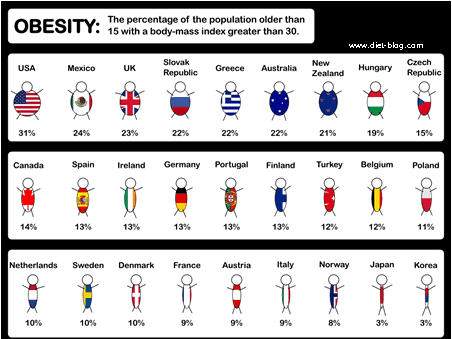
We only have to look at our neighbors to the south to see that we are not alone. Mexico ranks right up at the top with the U.S. in the worldwide rankings of the most obese countries on the planet. In fact, the country’s Health Secretary, Jose Cordova, has expressed his concerns about the impact of his country’s growing diabetes epidemic. Pfizer’s launch of its Exubera inhaled insulin product in Mexico last year shows that there is a real demand, and a real obesity problem.

There is a growing polarization in worldwide nutrition. That is, there are the millions of starving people in third world and developing countries, and then there are the more than one billion overweight adults, at least 300 million of whom are obese.

In a country that has a significant issue with poverty, it seems to baffle the mind to think that Mexico could be amongst the heaviest populations in the world. According to the World Bank, extreme poverty has been cut from about 24 to 17 percent of the general population and from 42 to 27 percent in rural areas. This is accounted for by an expanding economy, boosted largely by free trade agreements such as NAFTA. Not to mention an estimated $20 billion that is remitted from Mexican workers in the U.S.

Economic issues still come into play. British newspaper The Guardian reports that 80 percent of Mexican schools don’t have access to drinking water. This is made up for by substituting soft drinks. Mexico is one of the world’s largest consumers of sugary carbonated drinks.

So maybe it comes as no surprise that companies like Pepsi and Coca Cola are trying to step in and play the good guys by advocating healthier living through exercise with school kids. Don’t expect them to plop down any money to help find ways to get clean water in schools.

Figures from a 2006 national survey stated that more than a quarter of Mexican children between five and 11 are too heavy – a 40 percent increase since 2000. It also revealed that 72 percent of Mexican adults are now over overweight or obese, which is slightly higher than in the U.S. That’s one statistic that Mexico would prefer not to compete with us on.

Check out Shaq’s Family Challenge to learn more about getting your entire family in shape- no matter where you might call home.