

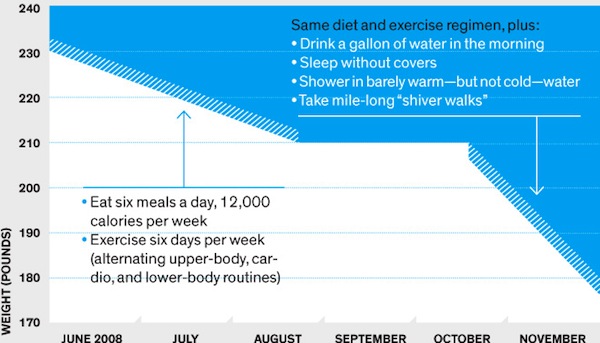





Ray Cronise, a former NASA scientist who spent 15 years overseeing experiments aboard shuttles at Marshall Space Flight Center, has been conducting experiments since 2008 to see if cold temperatures have an effect on the metabolism.
In 2008 while watching a televised program on Olympic swimmer, Michael Phelps, Cronise got an idea. The documentary claimed that the swimmer was consuming around 12,000 calories a day while training. That fact didn’t make sense to Cronise considering his own calorie-restricted diet allowed him to have only 12,000 calories per week.

At the time Cronise weighed 209 pounds at 5 feet 9 inches tall, and was trying to get down to 180 pounds. He thought to himself, if Phelps was really consuming that many calories daily and was in the water three hours a day, then something didn’t add up because the swimmer would become a “blob.”
Read Full Post >
Which of the following statements are true?
a. A pound of feathers weighs the same as a pound of lead. 
b. We have to consciously decrease calories in or increase calories out in order to burn fat.
c. All triangles have three sides.
If we believe what we’ve been taught, A, B, and C are all true. However, it may come as a surprise (or not, considering the dramatic rise in obesity) that biologists have known for a long time that B is false. We do not need to consciously eat less or exercise more in order to burn fat.
How’s this possible?
There are at least three major biological missteps with calorie counting:
1. It assumes calories out is fixed.
2. It assumes we can calculate calories out.
3. It assumes fewer calories in or more calories out requires the body to burn fat.
Read Full Post >
By Bob Greene for BestLifeDiet.com
How many hours of sleep did you get last night? If you answered seven (or right around there), then you’re in great shape—seven seems to be the magic number for sleep, according to new preliminary research.
You may already know that skimping on shuteye is associated with a number of problems. Your ability to focus and your reflexes are impaired, which can lead to accidents and decreased productivity. Then, there’s a whole host of physical changes that occur when you’re sleep deprived. For instance, your metabolism slows down and your body pumps out more ghrelin, the hunger hormone, and less leptin, the hormone that signals fullness, putting you at an increased risk for obesity and diabetes.
That’s enough to make you want to pull the covers over your head! But researchers from Brigham and Women’s Hospital in Boston found that too much sleep is not good for you either. In fact, it seems to impair memory and brain function.
Using data collected from 120,000 nurses who are part of the Nurse’s Health Study, the researchers found that those who logged less than five or more than nine hours of slumber per night scored lower on cognitive tests than those who slept around seven. (They presented their findings at the recent Alzheimer’s Association International Conference.) That means that logging the right amount of sleep may help keep your brain sharp and potentially protect against dementia as you get older.
Read Full Post >
“Long-term health and fitness is about the quality of food we eat and exercise we get, not the quantity.” This is how Jonathan Bailor sums up the research found in his new book, “The Smarter Science of Slim. Scientific Proof. Fat Loss Facts!” The book is full of research that points to so many flaws in our current beliefs on dieting and exercise. It’s research that men and women around the country have been relying on to help them finally breakthrough their weight loss; it’s also been assisting former Biggest Loser contestants after they leave the infamous ranch.
A catchy line throughout the book and the press info regarding the book is “eat more, exercise less.” It isn’t a catchy marketing line for Bailor to sell a diet pill, a weight loss device, or even a plan, it sums up the science and research he presents in the book.
Bailor explained that the science in his book is “shockingly different from marketing and common dieting myths.” It shows that the key to long-term fat loss and improved health is in the consumption of satisfying, unaggressive, nutritious foods like water-, fiber- and protein-rich non-starchy vegetables, nutrient-dense proteins, and whole food natural fats. When we eat this way, he explains that we’re too full for dry, low-fiber, and protein-poor starches and sweets, like bread, candy, cake, soda, and juice.
Read Full Post >
Finding ways to increase your metabolism is always important when you are trying to lose weight. There are tons of studies done to figure out which foods will naturally help your metabolism as well as products you can buy that claim to also help.
In my opinion, I prefer to stick with more natural remedies. I like to know exactly what I’m taking and how much. I did some research and found some of the most proven natural methods that will set your metabolism ablaze!
Maybe one of the most widely known ways to increase your metabolism is eating hot peppers. The reason they are able to help with metabolism is because of the chemical capsaicin, it is found in hot peppers and cayenne peppers. This chemical will temporarily cause your body to release more stress hormones, which will cause your metabolism to speed up and help you burn more calories. It will also help suppress your appetite which of course means taking in less calories. Eat a tablespoon of chopped red or green chili peppers at each meal by adding it to your meals. You can spice up your favorite pasta, chili or soups by adding these metabolism fire starters.
If you’re not a fan of the spicy peppers, the sweet chili peppers are another great option. They contain a compound called dihydrocapsiate (DCT) which acts similar to capsaicin as far as our metabolism goes. A study done in California found that people who took nine milligrams of DCT experienced more energy expenditure and burned more calories than the control group. They burned an extra 100 calories per day when they took the nine milligrams three times a day.
Read Full Post >