By Melissa Breyer for Care2.com
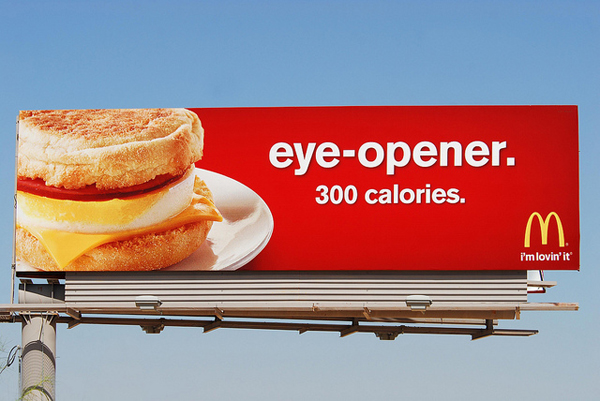
How would you like to meet your daily sodium and saturated fat allowance, as well as nearly half of your daily calorie needs, in one quick breakfast eaten on the road? It’s becoming progressively easy these day as food technicians, chefs and market researchers, holed away in corporate fast food “studios,” are busy developing monstrous new breakfast items. Trying to claim as much of the $57 billion fast food breakfast market as they can, the fast food giants are drumming up increasingly cheesy, steak-y, fried chicken-y breakfast dishes that tap into flavor combinations that have proven successful for lunch and dinner items. It’s no longer eggs and English muffins for fast food breakfast…breakfast burger anyone?
What’s most striking about some of these high-calorie items–aside from the unsustainable, industrial, often GMO and synthetic ingredients–is the very high sodium and saturated fat content. According to the USDA, the current recommendation for sodium consumption is less than 2,300 milligrams a day. For saturated fat, the maximum allowance is between 18 grams to 31 grams, depending on your caloric intake needs. (You can calculate your caloric need with this calculator from the Mayo Clinic.) Many of these breakfast items meet or exceed the daily sodium and fat allowances, and provide much more than one-third of your daily caloric needs.
Read Full Post >
By Karen Sherwood for NutritiousAmerica.com
These early fall mornings all we want to do is crawl back under our warm covers and sleep for an hour longer. Late, we usually run out the door forgetting the most important meal of the day: breakfast.
We’ve all been told the statistics about how breakfast ignites the metabolism (literally breaking the fast) and how skipping breakfast is associated with obesity; but when we are late for work and still half-asleep statistics are easily ignored. As are nutrition labels. So when we don’t skip, we grab something unhealthy but convenient that puts us at a nutritional disadvantage all day.
But don’t stress. You can still hit the snooze button. You can still run out of the door at the last second possible. We at Nutritious America will keep it simple. We will review three convenience-type breakfast products and give you some healthy, also convenient, alternatives.
Read Full Post >
By Melissa Breyer for Care2.com
Oh, for the day when the worst thing you could do to your coffee was add a hundred calories in cream and sugar. These days, most of the health atrocities being committed in the name of coffee come to us courtesy of the ubiquitous coffee-house and fast food chains that are colonizing our neighborhoods from sea to sea. Why do they see the need to turn a cup of coffee into a concoction capable of ringing up four-figure calorie counts? (Aside from the fact that consumers are scarfing them up…)
A plain cup of brewed coffee has only two calories and no fat. Even adding 49 calories from a tablespoon of sugar, 20 calories from a tablespoon of half and half, or 52 calories from whipping cream–a regular coffee can’t come close to competing with the desserts-in-coffee-cups listed here.
For a little perspective, keep this in mind: the range of recommended calories is from 1,600 to 2,400 calories per day for adult women and 2,000 to 3,000 calories per day for adult men, depending on age and physical activity level.
Read Full Post >
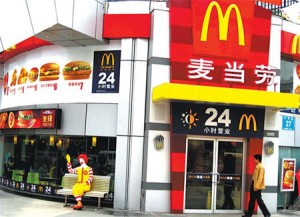
One of my memories as a child was going to McDonald’s to get a Happy Meal. (It happened maybe once every six months.) I knew that my mom didn’t think that the Happy Meal was a healthy meal, but it was a treat. I still wanted to eat it more often, like my friend Beth, whose parents took her to McDonald’s every week. My mom didn’t think it was healthy, and so we weren’t allowed to have it often.
The Happy Meal that I remember is still the same. The hamburger, fries and a drink meal that was first debuted more than 30 years ago has remained virtually unchanged, although apples and low-fat milk were introduced as options in 2004 in an effort to make the kids favorite more healthy. Unless specifically requested, however, each Happy Meal included a 2.4 ounce serving of french fries. Now that I have children, I (shh!) make the same choice as my own mother – McDonald’s isn’t a healthy choice for my family and so we visit rarely.
McDonald’s is hoping to change our minds.
Read Full Post >
It’s breakfast time and you want to start your day off right with a healthy and nutritious meal that doesn’t take long to make. You open your pantry and grab the Fiber One Original cereal. Then for lunch time, you are away from home so you run to McDonald’s and get their Premium Southwest Salad with Grilled Chicken. Around 3:00, you need a snack so you snack on some Wheat Thins Fiber Selects. Then for dinner, you have some spaghetti and meatballs from Pizza Hut.
What do all of these foods have in common? They all contain wood cellulose, which means that you are eating wood. Many companies, including those listed above, use wood cellulose in their foods all the time, and therefore, you are eating wood on a fairly regular basis. It is shocking to realize that many of the foods we eat when we are trying to make healthier options are so processed that they really are not as healthy as we may have thought.
Read Full Post >