







<?xml version="1.0" encoding="UTF-8"?>
<rss version="2.0"
	xmlns:content="http://purl.org/rss/1.0/modules/content/"
	xmlns:wfw="http://wellformedweb.org/CommentAPI/"
	xmlns:dc="http://purl.org/dc/elements/1.1/"
	xmlns:atom="http://www.w3.org/2005/Atom"
	xmlns:sy="http://purl.org/rss/1.0/modules/syndication/"
	xmlns:slash="http://purl.org/rss/1.0/modules/slash/"
	>

<channel>
	<title>Diets in Review Blog &#187; insulin</title>
	<atom:link href="http://www.dietsinreview.com/diet_column/tag/insulin/feed/" rel="self" type="application/rss+xml" />
	<link>http://www.dietsinreview.com/diet_column</link>
	<description>Diet Column - bringing you all the best diet news and opinions</description>
	<lastBuildDate>Sun, 22 Nov 2009 06:00:39 +0000</lastBuildDate>
	<generator>http://wordpress.org/?v=2.8.5</generator>
	<language>en</language>
	<sy:updatePeriod>hourly</sy:updatePeriod>
	<sy:updateFrequency>1</sy:updateFrequency>
			<item>
		<title>Fat Controls Your Brain, Eating Impulses</title>
		<link>http://www.dietsinreview.com/diet_column/09/fat-controls-your-brain-eating-impulses/</link>
		<comments>http://www.dietsinreview.com/diet_column/09/fat-controls-your-brain-eating-impulses/#comments</comments>
		<pubDate>Sun, 27 Sep 2009 06:00:01 +0000</pubDate>
		<dc:creator>Jason</dc:creator>
				<category><![CDATA[Nutrition & Health]]></category>
		<category><![CDATA[appetite suppressant]]></category>
		<category><![CDATA[fat]]></category>
		<category><![CDATA[insulin]]></category>
		<category><![CDATA[overeating]]></category>
		<category><![CDATA[research studies]]></category>

		<guid isPermaLink="false">http://www.dietsinreview.com/diet_column/?p=12432</guid>
		<description><![CDATA[If you&#8217;ve ever thought that your favorite food was &#8220;calling your name,&#8221; irresistibly drawing you to the refrigerator, it&#8217;s not just all in your head. Well, actually it is in your head. But, it&#8217;s very real. Let me explain&#8230;
A study at the University of Texas Southwestern Medical Center at Dallas has found that fat from [...]]]></description>
			<content:encoded><![CDATA[<p><a title="french fries" href="http://www.dietsinreview.com/diet_column/09/fat-controls-your-brain-eating-impulses/"  target="_self"><img class="alignleft size-full wp-image-12501" title="french fries" src="http://www.dietsinreview.com/diet_column/wp-content/uploads/2009/09/french-fries.jpg" alt="french fries" width="300" height="230" /></a>If you&#8217;ve ever thought that your favorite food was &#8220;calling your name,&#8221; irresistibly drawing you to the refrigerator, it&#8217;s not just all in your head. Well, actually it <em>is</em> in your head. But, it&#8217;s very real. Let me explain&#8230;</p>
<p>A study at the <a title="university of texas southwestern medical center" href="http://www.eduinreview.com/school-search/colleges/university-of-texas-southwestern-medical-center-dallas/" onclick="javascript:pageTracker._trackPageview('/outbound/article/www.eduinreview.com');" target="_blank">University of Texas Southwestern Medical Center</a> at Dallas has found that fat from certain foods goes to the brain and triggers the brain to send messages to the cells in the body, telling them to ignore the <a title="hoodia" href="http://www.dietsinreview.com/diets/Hoodia/"  target="_self">appetite-suppressing</a> signals from leptin and <a title="insulin resistance diet" href="http://www.dietsinreview.com/diets/The_Insulin_Resistance_Diet/"  target="_self">insulin</a>.</p>
<p>The interference with the leptin and insulin hormones, which are involved in regulating your weight, goes on for up to three days.<span id="more-12432"></span></p>
<p>&#8220;Normally, our body is primed to say when we&#8217;ve had enough, but that doesn&#8217;t always happen when we&#8217;re eating something good,&#8221; says researcher Deborah Clegg. &#8220;[The] entire brain chemistry can change in a very short period of time. Our findings suggest that when you eat something high in fat, your brain gets hit with the fatty acids, and you become resistant to insulin and leptin.&#8221;</p>
<p>The researchers found that one particular <a title="brown fat" href="http://www.dietsinreview.com/diet_column/04/fight-fat-with-brown-fat/"  target="_self">type of fat</a> (palmitic acid), found in beef, butter, cheese and milk, is particularly powerful in bringing about this phenomenon.</p>
<p>That explains my craving for a cheeseburger with buttered buns and a glass of milk today.</p>
<p>(via: <a title="diet and nutrition" href="http://www.msnbc.msn.com/id/32856334/ns/health-diet_and_nutrition/" onclick="javascript:pageTracker._trackPageview('/outbound/article/www.msnbc.msn.com');" target="_blank">MSNBC</a>)</p>
<p>Post from: <a href="http://www.dietsinreview.com/diet_column" >Diets in Review Blog</a></p>
<p><a href="http://www.dietsinreview.com/diet_column/09/fat-controls-your-brain-eating-impulses/" >Fat Controls Your Brain, Eating Impulses</a></p>
]]></content:encoded>
			<wfw:commentRss>http://www.dietsinreview.com/diet_column/09/fat-controls-your-brain-eating-impulses/feed/</wfw:commentRss>
		<slash:comments>0</slash:comments>
		</item>
		<item>
		<title>Vitamin K Helps Fight Diabetes</title>
		<link>http://www.dietsinreview.com/diet_column/06/vitamin-k-helps-fight-diabetes/</link>
		<comments>http://www.dietsinreview.com/diet_column/06/vitamin-k-helps-fight-diabetes/#comments</comments>
		<pubDate>Sat, 20 Jun 2009 06:00:38 +0000</pubDate>
		<dc:creator>Jason</dc:creator>
				<category><![CDATA[Nutrition & Health]]></category>
		<category><![CDATA[diabetes]]></category>
		<category><![CDATA[insulin]]></category>
		<category><![CDATA[kale]]></category>
		<category><![CDATA[research studies]]></category>
		<category><![CDATA[vegetables]]></category>
		<category><![CDATA[vitamin k]]></category>
		<category><![CDATA[vitamins]]></category>
		<category><![CDATA[weight]]></category>

		<guid isPermaLink="false">http://www.dietsinreview.com/diet_column/?p=9264</guid>
		<description><![CDATA[Experts are always finding new and interesting benefits that come with certain vitamins or minerals. This time around, it&#8217;s vitamin K and how it may help you avoid diabetes.
In a study, those subjects (older men and women) who took a vitamin K supplement for three years had lower blood levels of insulin. They also experienced [...]]]></description>
			<content:encoded><![CDATA[<p><a href="http://www.dietsinreview.com/diet_column/01/have-your-kale-and-eat-it-too/" ><img class="alignleft size-full wp-image-9370" title="kale" src="http://www.dietsinreview.com/diet_column/wp-content/uploads/2009/06/kale.jpg" alt="kale" width="227" height="225" /></a>Experts are always finding new and interesting benefits that come with certain vitamins or minerals. This time around, it&#8217;s vitamin K and how it may help you avoid <a title="diabetes diet" href="http://www.dietsinreview.com/topics/diabetes/"  target="_self">diabetes</a>.</p>
<p>In a study, those subjects (older men and women) who took a vitamin K supplement for three years had lower blood levels of <a title="The Insulin Resistance Diet" href="http://www.dietsinreview.com/diets/The_Insulin_Resistance_Diet/"  target="_self">insulin</a>. They also experienced an improvement with insulin resistance as compared to another group who did not take the supplement.</p>
<p>Here comes the catch&#8230;<span id="more-9264"></span></p>
<p>It doesn&#8217;t necessarily work the same if you are overweight. So, don&#8217;t look at it as a magic bullet. Men in the study seemed to benefit more from the K supplement, presumably because more of the women were overweight. Since being overweight contributes to insulin resistance, it diminishes the benefits of <a title="MyVitaminsRx" href="http://www.dietsinreview.com/diets/MyVitaminsRx/"  target="_self">vitamin K</a>.</p>
<p>Why not try to get vitamin K naturally? You can do so by making your salad greens darker and avoiding the iceberg. Think green, leafy vegetables like spinach, romaine lettuce, and broccoli. Other sources packed with vitamin K include <a title="kale recipes" href="http://www.dietsinreview.com/diet_column/01/have-your-kale-and-eat-it-too/"  target="_self">kale</a>, swiss chard, Brussel sprouts, and collard greens.</p>
<p>(via: <a title="real age" href="http://www.realage.com/ct/tips/8848" onclick="javascript:pageTracker._trackPageview('/outbound/article/www.realage.com');" target="_blank">Real Age</a>)</p>
<p>Post from: <a href="http://www.dietsinreview.com/diet_column" >Diets in Review Blog</a></p>
<p><a href="http://www.dietsinreview.com/diet_column/06/vitamin-k-helps-fight-diabetes/" >Vitamin K Helps Fight Diabetes</a></p>
]]></content:encoded>
			<wfw:commentRss>http://www.dietsinreview.com/diet_column/06/vitamin-k-helps-fight-diabetes/feed/</wfw:commentRss>
		<slash:comments>1</slash:comments>
		</item>
		<item>
		<title>7 Nutrition Tips Diabetics Need to Know</title>
		<link>http://www.dietsinreview.com/diet_column/11/7-nutrition-tips-diabetics-need-to-know/</link>
		<comments>http://www.dietsinreview.com/diet_column/11/7-nutrition-tips-diabetics-need-to-know/#comments</comments>
		<pubDate>Tue, 11 Nov 2008 15:26:41 +0000</pubDate>
		<dc:creator>Kinsey</dc:creator>
				<category><![CDATA[Nutrition & Health]]></category>
		<category><![CDATA[diabetes]]></category>
		<category><![CDATA[insulin]]></category>
		<category><![CDATA[Nutrition]]></category>

		<guid isPermaLink="false">http://www.dietsinreview.com/diet_column/?p=2579</guid>
		<description><![CDATA[What is Diabetes?
Simply put, when you eat food your body begins the digestion process and breaks down the sugar (or carbs) into glucose. The glucose is then absorbed into the blood stream where it waits to enter the cells, so the body can use it for energy. Insulin helps get glucose into the cell. In [...]]]></description>
			<content:encoded><![CDATA[<p><a href="http://www.dietsinreview.com/diet_column/wp-content/uploads/2008/11/diabetes-monitor.jpg" ><img class="size-medium wp-image-2593 alignleft" title="diabetes-monitor" src="http://www.dietsinreview.com/diet_column/wp-content/uploads/2008/11/diabetes-monitor.jpg" alt="" width="216" height="282" /></a><strong>What is Diabetes?</strong></p>
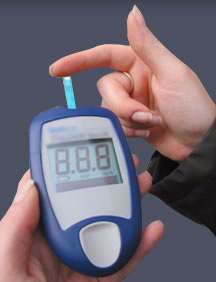
<p>Simply put, when you eat food your body begins the digestion process and breaks down the sugar (or carbs) into glucose. The glucose is then absorbed into the blood stream where it waits to enter the cells, so the body can use it for energy. Insulin helps get glucose into the cell. In people with <a title="diabetes" href="http://www.dietsinreview.com/topics/diabetes/"  target="_self">diabetes</a>, there may not be enough insulin to get the glucose in; therefore the glucose sits in your blood and gives a high reading when you test your blood glucose level.</p>
<p>Diabetes can affect anybody! Here are a few different types of diabetes:</p>
<ul>
<li><strong>Type I</strong> (Insulin Dependent)- anyone who is dependent on insulin to keep their blood glucose levels under control because their pancreas does not produce insulin.</li>
<li><strong>Type II </strong>(Non-Insulin Dependent)- anyone who can control their blood glucose levels with diet, exercise, and/or oral medications. Their pancreas typically secretes insulin, but the body has built a resistance and doesn’t utilize it sufficiently.</li>
<li><strong>Medication Induced</strong>- when medications cause an increase in blood glucose levels</li>
<li><strong>Gestational</strong>- when a woman develops high blood glucose levels during a <a title="pregnancy" href="http://www.dietsinreview.com/topics/pregnancy/"  target="_self">pregnancy</a>.<span id="more-2579"></span></li>
</ul>
<p><a href="http://www.dietsinreview.com/diet_column/wp-content/uploads/2008/11/healthy-eating1.jpg" ><img class="size-medium wp-image-2594 alignright" title="healthy-eating1" src="http://www.dietsinreview.com/diet_column/wp-content/uploads/2008/11/healthy-eating1.jpg" alt="" width="250" height="251" /></a><strong>Nutrition and Diabetes</strong></p>
<p>A few basic nutrition ideas diabetics need to keep in mind:</p>
<ol>
<li><strong>Eat Breakfast</strong>- It kick starts your metabolism, and since you’ve been fasting all night your blood glucose levels may be low and you need to replenish lost stores.</li>
<li><strong>Don’t Skip Meals</strong>- Skipping meals can lead to low blood sugar levels (hypoglycemia).</li>
<li><strong>Eat Often</strong>- Try to eat every 3-4 hours to keep you blood sugar levels in control in order to help you avoid the real highs (hyperglycemia) and the real lows (hypoglycemia).</li>
<li><strong>Get on a Schedule</strong>- Try to eat at the same time every day. This will help regulate your blood sugar.</li>
<li><strong>Eat Balanced Meals</strong>- Make sure you eat protein and fat with your carbs. This will slow down the absorption of the carb (which in return helps regulate your blood sugar).</li>
<li><strong>Decrease Total Carb Intake</strong>- The more carbs you eat, the more glucose will be in your blood, the less able you are to clear the glucose (keeping you hyperglycemic).</li>
<li><strong>Check your blood sugars</strong> repeatedly throughout the day.</li>
</ol>
<p>Living a life with diabetes can be an easy thing as long as you stay in tune with your body, eat properly, exercise, and check your blood sugar often.</p>
<p>Post from: <a href="http://www.dietsinreview.com/diet_column" >Diets in Review Blog</a></p>
<p><a href="http://www.dietsinreview.com/diet_column/11/7-nutrition-tips-diabetics-need-to-know/" >7 Nutrition Tips Diabetics Need to Know</a></p>
]]></content:encoded>
			<wfw:commentRss>http://www.dietsinreview.com/diet_column/11/7-nutrition-tips-diabetics-need-to-know/feed/</wfw:commentRss>
		<slash:comments>1</slash:comments>
		</item>
	</channel>
</rss>
