

Diets in Review - Find the Right Diet for You

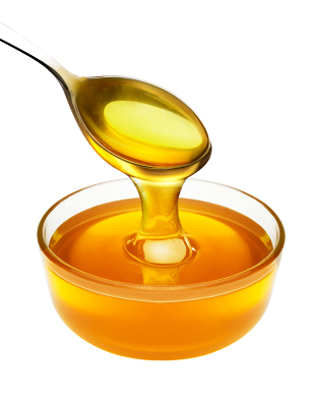
honey


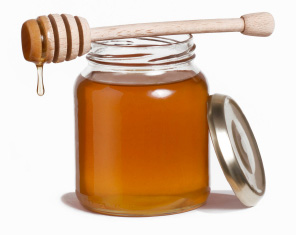
A Spoonful of Honey Helps Cure Sleepless Nights from Coughing

Growing up, I remember singing Mary Poppins’ song, “A spoonful of sugar helps the medicine go down.” While I didn’t understand the song, I knew that it was catchy. And while I still cringe at the thought of taking cough syrup, especially because of the high fructose corn syrup that can be found in most bottles, it seems sweet relief is on its way. According to a new study, as reported by FoxNews, a spoonful of honey could help kids and parents both cope with nighttime coughs.

The new study, published in Pediatrics, shows researchers from Israel took 300 kids, ages 1 to 5, and had them try 1 of 4 nighttime cough treatments. Parents would give their children 2 teaspoons of honey or one of three placebos 30 minutes before bed. The following week, on a 7-point scale, parents rated how their children slept. The study, led by Dr. Herman Avner Cohen of Tel Aviv University, found children who were given honey slept better and reduced their coughing more than those who took the placebo. Parents also reaped the benefits by sleeping through the night!
Read Full Post >


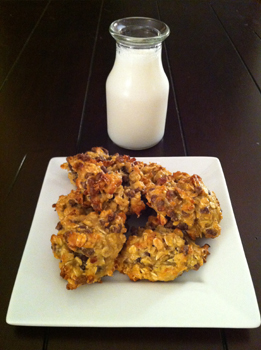
An Oatmeal Chocolate Chip Cookie Baking Accident with a Lower Calorie Surprise

Full disclosure: I’m a terrible baker. My husband warns people not to eat anything I bake.

That said, I get the itch to bake periodically and it always has to be scratched. Quiet, uneventful Sunday afternoons get the better of me and my well-stocked pantry. Once I’ve made up my mind, the oven’s on and the flour’s flying.

This past Sunday, I was already in cooking mode, with Chef Devin’s turkey meatballs and homemade marinara simmering on the stove (see the Biggest Loser Family cookbook). When I pulled the oats out of the cabinet to combine with the turkey, I immediately thought “cookies!”. I also had mini chocolate chips left over from a birthday party the previous weekend. A couple of tiny cookies would be the perfect end to our dinner and weekend.

I started reading through the ingredients listed on the oatmeal container and pulling each out of the cupboard and refrigerator. It called for butter. I froze. No butter. Then I remembered the healthier baking swaps article we did last year, and recalled Marisa Churchill’s suggestion for replacing butter with cream cheese. An entire brick of neufchâtel cheese sat in my fridge. Ball dodged.

Then it called for granulated sugar. Completely out. So I Googled “honey replacement for sugar” and found several suggestions for a 1:1 swap. Completely doable.
Read Full Post >


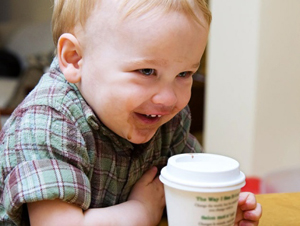
3 Reasons Babyccinos are the Antithesis of a Healthy Toddler Diet

I heard about it on NPR this weekend while on a mini road trip, but you may have already heard about it from a number of news sources or even Facebook. Babyccinos are a trend, it would seem, or at least a trending search term. As I did some digging, it seems that such things have existed in Australia and London for a while. In the U.S. it may be most popular in Brooklyn, I cannot say it is completely unheard of here in the midwest either. Babyccinos are coffee-like beverages intended for very young children. There are different versions that have been discussed some with steamed milk, some with honey, and some with a shot of decaf espresso. While babyccinos may be a trend that is over reported, the danger cannot be overstated.

1. Espresso – Even decaffeinated espresso or decaffeinated coffee is not free of caffeine; the amount of caffeine has just been reduced. The effects of caffeine on children will be exaggerated due to their small size, and as anyone who has ever had to skip their morning coffee knows, caffeine is a drug without which withdrawal symptoms will be experienced. At what age do you really want to introduce that to your children? It is also important to note that to remove caffeine from coffee beans a chemical solvent must be used.
Read Full Post >


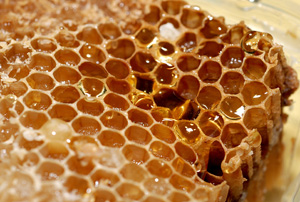
Majority of Honey on Grocery Store Shelves is Not Actually Honey

According to a test run by Food Safety News, a vast majority of the honey lining grocery store shelves may not actually be honey.

Results of the study showed that the pollen typically found in honey is often filtered out through a high-tech procedure called ultra-filtering. Without this pollen, it’s difficult to identify where the honey in question originated from and whether it is in its purest form. From plastic bears to jugs and jars, it can be a real challenge to identify which products are your best bet. To help you out, here are a few guidelines to help you select real honey every time:

What you need to know

With a vast majority of our honey being ultra-filtered, it’s important to know what that means. In some instances, it may mean that there is indeed very minimal amounts of real honey present within the product; however, in most cases it most likely means that the purity of the honey isn’t as clear cut as you thought it might be. According to the study done by Food Safety News, most of the honey lining our grocery store shelves have had their pollen removed. In fact, 76-100% of the samples retrieved from some of America’s biggest grocery store chains tested negative for pollen.


Read Full Post >


Eat More Honey for National Honey Month

This month is National Honey Month and it just so happens that this week, we’re all about honey. Between the Jewish New Year, which includes a tradition of dipping apples in honey for a “sweet” New Year to First Lady Michelle Obama’s honey beehive at the white house, we just can’t get enough. Plus, there is just no denying that the sweet sugar alternative has some astounding health benefits.

According to the National Honey Board, Americans consume nearly 1.5 pounds of honey per year annually. While honey is certainly not new, it has recently gained popularity as a healthy alternative to sugar. At 60 calories per tablespoon, honey offers a number of advantages.


Read Full Post >