

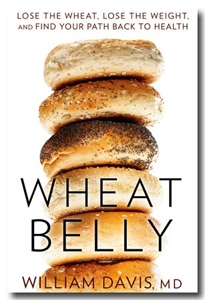
A few weeks ago my friend Michelle McNally tweeted a link to this interview with Dr. William Davis, author of Wheat Belly. I was impressed with Dr. Davis, so I put it on my hold list at the library and started discussing it with people I respect. Michelle had already made several dietary changes for her family after her daughter was diagnosed with multiple (17) food sensitivities, but she changed her own diet even when her daughter was not around after reading this interview. Beyond wheat free, Michelle’s daughter is also sensitive to yeast, which eliminates some wheat-free choices in addition. 
Hazel Walker is an author, speaker, and personal mentor. She states, “at age 55 I am looking closely at the cause and effect that some foods are having on MY Body. I had already given thought to wheat being an issue, this just confirmed what I thought.” Hazel has committed to 31 days wheat free. She taught me that gluten free, does not always mean wheat-free.
What really caught my attention was the quote from Dr. Davis, “what you are being sold called “wheat” is really not wheat at all, at least nothing like the wheat of 1950 that our mothers and grandmothers had. Modern wheat is the product of extensive genetics experiments conducted during the 1960s and 1970s to increase yield.” Eliminating partially hydrogenated soybean oil and high fructose corn syrup were my first steps to purifying my diet, and I have made every effort to avoid genetically modified foods. The thought that there may not be non-genetically modified wheat available in the United States any longer is frightening to me. I normally promote a balanced diet, avoiding processed foods but not any foods in particular. Cutting out wheat sounds very drastic, but as Dr. Davis says, “I don’t think that modern wheat should even be considered food…Modern wheat is not a creation of nature. It is the creation of geneticists.”
Read Full Post >
High fructose corn syrup, found in sodas, cereals and baked goods, has become a food bad guy for its link to obesity and diabetes but it might not only be food the sticky stuff is lurking in. Some common cough and cold syrups use high fructose corn syrup (HFCS) as their sweeteners, the most popular offenders including Vicks, Delsym and Robitussin brands.
Cough and cold syrup makers could use other sweeteners like sucrose but HFCS is inexpensive to manufacture. High fructose corn syrup is a chemically made sugar that primarily contains fructose (fifty-five percent,) glucose (fourty-five percent) and water. The good news is that the companies clearly list HFCS as an inactive ingredient on their labeling, which means it will have no effect on suppressing a cough, for example.
“One teaspoonful of pure HFCS has 3.8 grams of carbohydrates and is about 15 calories,” Mary Hartley, RD, our registered dietician, states, “but 1 teaspoonful of cough syrup is not one-hundred percent HFCS.” The amount HFCS that is in cough syrups compared to the rest of the ingredients is not something that is clearly labeled on their packaging. When I tried to contact a representative from Vick’s about how much of the sweetener was in their product, the rep told me the information was proprietary and legally they may not be allowed to release the information.
Read Full Post >
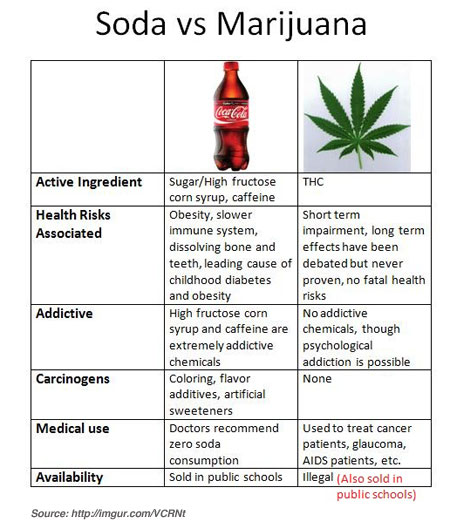
There’s a chart that has been floating around the Internet for a while comparing various health effects of soda and marijuana. The agenda doesn’t appear to be pro-pot as much as it is pointing out societal hypocrisy and the serious dangers associated with foods most of us have no moral issue with.

I would be the first to get in line with people who think the demonizing of marijuana in Western culture has always been taken to an extreme level. However, if you think it somehow comes without any serious health risks, you need to consider putting the bong down for a moment and read on. Let’s take a look at how soda and marijuana really compare:
Carcinogens - Let’s start with the biggest hole in the chart’s argument: that there are no carcinogens in marijuana. According to Donald Tashkin, MD, a researcher at UCLA’s David Geffen School of Medicine, there are as many or more carcinogens and co-carcinogens in marijuana smoke as in cigarettes. Inhaling carcinogens for a long period of time can’t be harmless, can it?
Read Full Post >
Obesity rates and other related statistics are rolled out every year, sometimes even more frequently, with each seeming worse than the last. The U.S. is on a fast train that’s heading towards a brick wall, unless something can be done to put on the brakes, and better yet, put it in reverse!
The overriding question that has to be on everyone’s mind is how did we get here and why does it seem we are helpless when it comes to making better food and lifestyle choices?
There is no doubt that a major component to our growing obesity problem is that we are less active than ever before. We live in a technology-based world where more and more of us sit in front of computers and televisions (remember when you didn’t have 300 channels and the entire world’s information at your fingertips?). Even careers in manual labor fields that provide some form of physical exercise have become more automated.
Read Full Post >
Who didn’t grow up eating peanut butter sandwiches? While peanut butter and jelly has been a lunchbox staple for as far back as anyone can remember, the delicious sandwich spread is far from diet-friendly.
“Peanut butter in its basic or pure form is a healthy source of protein,” said Oliver Gerard Heffern, owner of glor foods. “It’s what’s added there after that can cause concern: sugars, preservatives, additives and colors.”
According Brandon May, author of The Healthy Advocate, peanut butter label claims can be be misleading. “No matter which brand, any peanut butter labeled ‘reduced fat or ‘low-fat’ should be avoided,” May said. “They typically have fillers that increase the sugar content, making them potentially more harmful to your health than a higher fat version.”
Additionally, most commercial peanut butters have oils that have been fully or partially hydrogenated, which creates trans-fat. “It isn’t peanut fat that’s a problem, it is the trans-fats in the peanut butters that contributes to poor health,” said May. “Any peanut butter labeled ‘natural’ or ‘organic’ will not have hydrogenated oils, but you should always check the label to see the sugar content.”
Read Full Post >