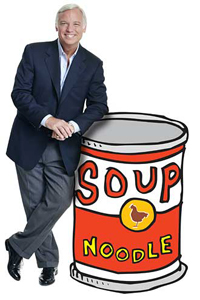
The man who would one day dominate the published Chicken Soup series, Jack Canfield, was born August 19, 1944 in Forth Worth, Texas. Not much is said about his parents or his childhood in the media, but we do know that Jack attended Linsly Military Institute, a boarding school in Wheeling, West Virginia. After high school, Jack left West Virginia for Harvard, from which he graduated in 1966 with a bachelor’s degree in Chinese history.
In 1971, Jack married his first wife Judith, whom he met while studying for his master’s degree at the University of Massachusetts. The couple had two children before divorcing in 1976. Just two years later, Jack married Georgie Lee Noble and together they had a son.
The consummate student, Jack received an honorary Ph.D from the University of Santa Monica in 1981. And nearly a decade later, in 1990, Jack met Mark Victor Hansen, with little knowledge that the two would become successful business partners. Mark and Jack had the idea of collecting inspirational stories and compiling them into a single book that would appeal to everyone. Three years later, Chicken Soup for the Soul was published, and together Jack and Mark climbed to the top of bestsellers‘ ladder.
Read Full Post >
By Jill Buonomo
Many people grew up learning to base their food choices on the U.S. Department of Agriculture’s Food Pyramid, which was recently reinvented as MyPlate. The updated guidelines, communicated via a simple, color-coded graphic, are focused on proper portions of the four major food groups. The plate is divided into sections for proteins, grains, fruits and vegetables — with a glass of milk beside it representing the dairy group.
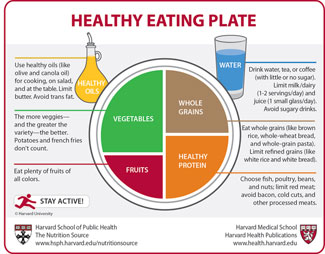
But does it go far enough? The researchers at the Harvard School of Public Health and Medical School didn’t think so. They’ve created their own guidelines, dubbed the Healthy Eating Plate. The Harvard guidelines are presented as a more specific alternative to the USDA’s MyPlate; an option based on science and created without any political or commercial pressures from food industry lobbyists.
The Harvard Difference
The Healthy Eating Plate is similar to USDA’s MyPlate in that it’s a colorful and graphical representation of a healthy diet. But it goes much further in terms of distinguishing healthy choices within each food group.
For example, a vegetable is not a vegetable in the eyes of the Harvard nutritionists. While the vegetable section is the largest, they suggest forgoing potatoes (and by extension, French fries) altogether. Likewise, whole grains are recommended over refined options like white rice and white bread.
Read Full Post >