When deciding where to workout, dedicated runners have a plethora of options. Between barefoot running, trailblazing, asphalt, concrete and the local track, it can be difficult to decide what choice is right for you.
Dr. Charles A. Mutschler, DPM is a medical director and podiatrist at Advanced Footcare of Miami. As an expert in the field, he acknowledges the fact that all types of running surfaces can provide both risks and benefits to the runner.
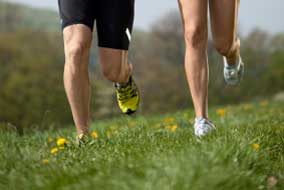
Running on sand, grass and dirt trails are all very common practices. Although running on these surfaces provides incredible shock absorption and muscle development, the uneven ground can contribute to slips, trips and falls. Runners who are not accustomed to the irregular terrain may find themselves straining and spraining the muscles in their feet and ankles.
Read Full Post >
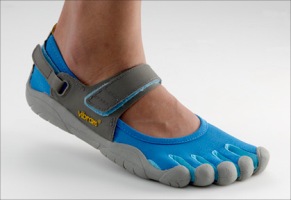
I was out running one morning about two years ago. It was a rare morning where I didn’t have music pumping in my ears. As I was approaching a turn, I began to hear an odd rhythm. It almost sounded like duck feet smacking the ground. As I got closer, I saw another runner coming towards me. The sound was coming from her shoes. She was wearing what looked like gloves on her feet as she trekked along. This was the first time I’d ever seen anyone run in the Vibram Fivefinger shoes. Flash forward two years and these shoes and the minimalist movement have grown tremendously popular. However, as with most popular things, it’s not all necessarily a good thing. There’s quite a bit of controversy over these shoes and the proper role they play in the sport of running.
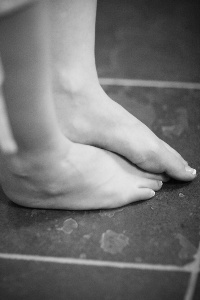
There’s lots of debate over the safety of minimalist running and barefoot running. There are also a lot of grey areas in the subject. While some shoes are minimal in the support they offer, they are not equivalent to a barefoot or even a Vibram. However, all members of the pro party tend to support the general theory that the stronger the foot, the better the runner will run.
Vibrams (pronounced “VEE-Brims”) claim that they allow the runner to land on their forefoot which results in optimum balance, improved stability, lighter impact, and increased propulsion. The Vibrams also claim to help correct form problems along with strengthening and stimulating muscles in the feet and lower legs.
So with such positive claims what’s the objection to this product? First Gear running shoe store owner, Gary Gregory, sees the Vibrams as a form of barefoot running and explained why he will not carry the product.
“Barefoot running is too radical of an idea from the norm, it’s too big of a departure and too big of a change for people who have been running in shoes for years.”
Read Full Post >
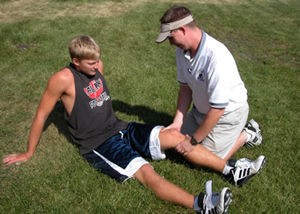
When an athlete gets injured, there’s a typical protocol. The usual treatments include physical therapy and sometimes surgery. These long standing treatments have been effective, but they take the athlete out of their game for quite some time. Lately, a new therapy has surfaced and athletes and doctors alike are loving the results. Plasma rich platelet and stem cell therapies are new treatments that are proving their worth and looking to become the new “go-to” therapy for injured athletes.
Plasma rich platelet (PRP) and stem cell therapies are administered by taking blood from the injured patient, placing the vial in a centrifuge to separate the components, and then injecting the plasma or stem cells back into the patient at the injury site. The healing elements of the PRP go to work directly on the injury and are claimed to speed the healing process. Stem cells work similarly.
In a nutshell, the patient is being treated with their own blood for expedited recovery.
Read Full Post >
We’ve all seen it, the little girl (let’s say she’s four) clomping around the house in her mother’s high heels. For some women, an obsession with shoes starts young and for others, it doesn’t emerge until the teen years, if ever. Personally, I always saw my mother in her high heels and the clicking sound they made as she walked across the floor made me think she was the most beautiful and powerful woman in the world. I love that sound even now and regardless of how irrational it seems to you, it makes me feel gorgeous.
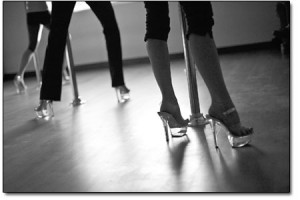
When I first heard about high heeled workouts, my initial reaction was “heck yes!” and then reality set in. The fact is, working out in high heels adds an entirely new level of possible injuries to your regimen. Consistently struttin’ your stuff in heels has been linked to weak muscles in the calves and ankles. Back and knee injuries also seem to be more common in women who regularly wear heels. Besides the more complicated physiological dangers, something as simple as your balance can be compromised when raised up on high heels. So then why the sudden surge in heel-based exercise classes?
Read Full Post >
No pain, no gain, right? Well, maybe in certain scenarios, this old motto is false. A runner in training should expect fatigue. They should expect muscle soreness. They should also anticipate that not every run will be a good one. But what about when these truths start piling up? Does the runner need to learn to push through or is it possible that backing off will be the key to their success?
While it might not seem possible, a runner can actually over-train and negatively impact their performance.
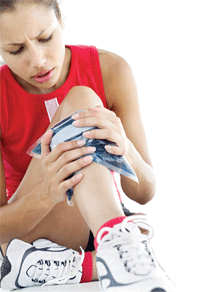
Over-training is characterized as not allowing the body to rest and recover from the stress of training. If the body can’t catch up on the much needed repair time, the athlete’s performance will suffer. This is a very serious problem. Over-training has the potential to ruin one’s running career if not taken seriously. If the body gets into a state of over-training, it’s very difficult to recover.
Read Full Post >