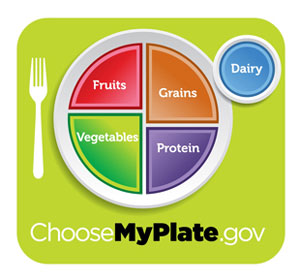
Earlier this year the USDA unveiled the MyPlate icon, replacing the MyPyramid graphic in an effort to simplify dietary recommendations for the American public. Yet despite the early excitement surrounding its unveiling, it appears not many Americans are choosing to implement the MyPlate guidelines.
In fact, most Americans are only meeting the MyPlate guidelines an average of one week out of the year. And this probably isn’t altogether that shocking given that most Americans fail to include vegetables or dairy at most meals. Additionally, the 2010 Dietary Guidelines for Americans, the recommendations visually depicted by the MyPlate icon, often require more than three meals to be eaten each day in order to be achieved which can also prove difficult for individuals who don’t snack in between meals.
So are the MyPlate guidelines really a diet in disguise that most people can’t stick to for longer than a week? Not exactly. The guidelines behind MyPlate result from years of study and observation of eating behaviors among thousands of Americans. These guidelines outline a lifestyle, not a diet, however without proper guidance they can be just as difficult to stick to.
When implementing the MyPlate guidelines, it’s important to know where to start and to have a little background information on what these guidelines mean. This, of course, requires you to go beyond the plate and develop your own MyPlate-based plan that works over the long-term. And although it’s easy to say this is something you want to do, actually doing it is a lot harder.
Read Full Post >
For those on the West Coast, In-N-Out Burger is a fast food legend. Every location almost always has a line of cars out and around the block with its patrons hungry for burgers, fries and shakes.
While not exactly healthy, nor an extensive menu, the regional fast food chain prides itself on the quality of its food. All burgers are made with 100 percent pure beef and are free of additives, fillers and preservatives, according to In-N-Out Burger’s website. Additionally, its American cheese is all real, the potatoes used for the fries are cut in each store, and no food is frozen, microwaved or stuck under a heat lamp. (It’s easy to see why they have a following, right?)
Freshness aside, we wanted to take a look at In-N-Out Burger’s nutritional menu to see if any options would meet our registered dietitian Rebecca Scritchfield’s healthy guidelines of having less than 500 calories and less than 500 milligrams of sodium, according to the the new daily sodium recommendations. Because the menu is so limited to begin with — and unfortunately the company doesn’t list nutritional facts on its underground “styles” of burger preparation like Monster and Animal — our list is pretty short.
Read Full Post >
Since the announcement of the new 2010 dietary guidelines for Americans, culinary experts and dietitians have been working to help their clients adjust their diets to reflect the new guidelines. One of these suggestions includes eating less sodium.
Registered dietitian Michelle Dudash, RD is working to help Americans do just that. Here are a few tips straight from her kitchen to help cut down your salt intake, which promotes overall heart health and may even help you slim down.
Hold the salt: Instead of adding salt throughout the preparation process, only add it at the end of cooking when it’s needed. This method requires less salt, while still reaching your taste buds upon first bite.
Think fresh: Use good quality, fresh and seasonal ingredients whenever possible, which results in maximum flavor and leaves little need for added salt.
Read Full Post >
Mary Hartley, RD, MPH, is the director of nutrition for Calorie Count, providing domain expertise on issues related to nutrition, weight loss and health. She creates original content for weekly blogs and newsletters, for the Calorie Count library, and for her popular daily Question-and-Answer section, Ask Mary. Ms. Hartley also furnishes direction for the site features and for product development.
UPDATE 1/31/2011: The 2010 Dietary Guidelines for Americans were released this morning. A full rundown on the changes can be found here.
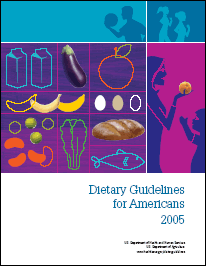
The nutrition community has been expectantly waiting for the 2010 Dietary Guidelines, which at this point, are a month late in their release. The Guidelines contain the authoritative information about the best diet to prevent disease. Since 1980, they have been published every five years by law.
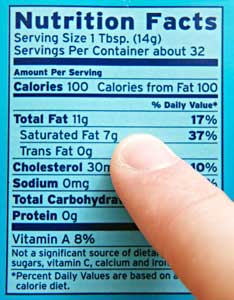
The Dietary Guidelines for Americans are jointly published by the Department of Agriculture (USDA) and the Department of Health and Human Services (HHS). They are revised to reflect scientific advances in the knowledge of what constitutes an ideal diet. They are the basis of Federal nutrition education programs, including My Pyramid and the Nutrition Facts labels, and they guide the foods that are offered by School Lunch, WIC and other Federal nutrition programs.
Read Full Post >
Michael Pollan had his 64 rules for eating healthy and in recent weeks, 13 scientists who were appointed to an advisory committee released their new “food rules”. This early release of “rules” is not yet the final dietary guidelines for Americans, so now is our chance to have some influence by providing our feedback. Final dietary guidelines will become available at the end of 2010, so make sure to give your 2 cents in our comments section and we will work to roll these up and help steer our country to a healthier place.
1. Eat fewer calories. The average person needs to consume roughly 2,000 calories per day. Most don’t know what they should consume for their individual height and weight, let alone how much they are actually eating. To find out what your daily calorie consumption should be, visit: DIR Health Calculator.
Read Full Post >