



By Abra Pappa for NutritiousAmerica.com
Before you refill that coffee mug read this.
Last week a new research study from Harvard was released that stated drinking caffeinated coffee may help women fight depression. Women who drank four or more cups of caffeinated coffee a day had a 20% decreased risk of developing depression over the 10 year period compared with those that consumed one cup or less a week, according to a study released in the Archives of Internal Medicine.
A holistic nutritionist weighs in:
I am concerned that this research is giving the green light to an extreme coffee habit, which in my opinion, can be ultimately detrimental to your health. When this study was released last week Twitter was filled with “tweets” of joy like, “coffee brews to beat the blues,” and this tweet from Arianna Huffington, “Caffeine can cure depression in women. One more reason for coffee addicts like me to celebrate our addiction.” Don’t get me wrong, I also enjoy a cup of Joe from time to time, but it’s how people tend to misread research to reinforce an unhealthy habit that’s got me down. Researchers cautioned that more study is needed before they’d recommend adding several cups of coffee a day as therapy, but how many people skipped over that caution?
And what about the negative effects of 4-5 cups of coffee per day?
Read Full Post >
By Melissa Breyer for Care2.com
Oh, for the day when the worst thing you could do to your coffee was add a hundred calories in cream and sugar. These days, most of the health atrocities being committed in the name of coffee come to us courtesy of the ubiquitous coffee-house and fast food chains that are colonizing our neighborhoods from sea to sea. Why do they see the need to turn a cup of coffee into a concoction capable of ringing up four-figure calorie counts? (Aside from the fact that consumers are scarfing them up…)
A plain cup of brewed coffee has only two calories and no fat. Even adding 49 calories from a tablespoon of sugar, 20 calories from a tablespoon of half and half, or 52 calories from whipping cream–a regular coffee can’t come close to competing with the desserts-in-coffee-cups listed here.
For a little perspective, keep this in mind: the range of recommended calories is from 1,600 to 2,400 calories per day for adult women and 2,000 to 3,000 calories per day for adult men, depending on age and physical activity level.
Read Full Post >
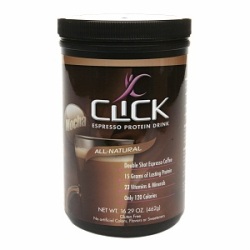
Confession: I am a coffee drinker. I can manage a french press myself. I drink it black. Despite a Starbucks in my family tree, I don’t find the coffee sold at that chain store up to my standards. I was skeptical about trying CLICK Espresso Protein Drink.
According to press releases, “CLICK is the brainchild of Greg and Beth Smith, a Fresno, California couple who owned a small chain of women’s fitness centers. The Smiths were seeking a delicious, healthy beverage for their members in response to the growing wall of sugar based energy and espresso drinks on the market.” The 15 grams of protein per serving is designed to provide sustained energy, in addition to the “two shots of espresso” or 100-150mg of caffeine per serving.
Read Full Post >
Good news if you like your cup of Joe dark roasted like I do! Researchers at the University of British Columbia have discovered that coffee’s antioxidant benefits seem to be traced to valuable compounds developed during the roasting process. According to previous research on coffee and health, java drinkers are less likely to die of heart disease, develop a malignant brain tumor and suffer from gout.
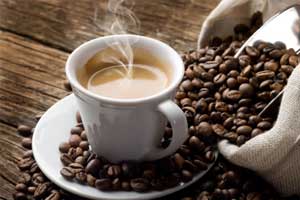
Coffee beans in their natural state are green. According to the study, food scientists found that the antioxidants found in dark roasted coffee that’s brewed actually comes from the process of green beans being browned under high temperatures. Previous studies believed the antioxidants came directly from the caffeine or the green coffee beans- not the roasting. The research is to be published in Food Research International.
Read Full Post >
There are many good things to say about Starbucks. They offer Fair Trade coffee, they’ve made a considerable effort to serve lower-calorie options and have cut artificial flavors and coloring out of their foods. I love their chai, which can be ordered with soy or low fat milk.
However, the new Trenta size is really pushing the limits of the human body. My first reaction to the new drink was visceral, the idea of that much caffeine and coffee makes my stomach hurt just thinking about it. Then I was sent a graphic from The National Post, revealing that the Starbucks Trenta is actually 16 milliliters bigger than the average human stomach. A iced Venti beverage hold 591 milliliters of liquid, a human stomach holds about 900 milliliters and the Trenta contains 916 milliliters. You may not want to drink one of these beverages before you go for a long drive, because your bladder can normally hold 400 to 600 milliliters.
The largest beverage size will be limited to iced coffee, Tazo shaken iced tea and iced tea lemonade. Starbucks tested the Trenta for about a year, which was created in response to consumer and employee suggestions. Happily, while these giant drinks may stretch your stomach, they won’t necessarily ruin your diet. May Kulthol, a spokeswoman for Starbucks, told The Wall Street Journal that unsweetened Trenta drinks have less than 90 calories, while the sweetened versions have 230.
Read Full Post >