Happy Year of the Dragon! It’s time to celebrate the Chinese New Year. Everyone loves a celebration and what would any celebration be without good food?
Although the holiday falls on a different date each year (this year it’s Jan. 23) the celebration only starts there, but continues for another fifteen days. That gives you more time to enjoy some of the delicious recipes that symbolize prosperity, luck, wealth or good fortune for the coming year.
Chinese culture is all about symbolism and the dishes served for New Years reflect the culture. Noodles represent a long life, but be sure not to cut or break them as you prepare, serve and eat them. A whole chicken represents family unity, a whole fish—surplus, tangerines are used for wealth and oranges for good luck. Steer clear of squid as it symbolizes getting fired in the upcoming year.
Check out these healthy versions of Chinese New Year dishes.
Is it possible to have healthy Chinese food? Just because you see a couple broccoli bits in that dish does not mean it’s healthy. In fact, Chinese takeout is among the worst offenders of the healthy eating guidelines; saturated fat and salt are through the roof with some dishes.
Case in point: an order of General Tso’s Chicken can set you back 1,600 calories, 3150 mg sodium (exceeds 2100 mg per day limit) and 59 grams of fat (11 grams saturated – heart clogging kind – about a day’s worth).
But don’t fret just yet, maybe you can have your fortune cookie and eat it too. Watch this video to learn how you can have healthy Chinese takeout.
Chinese food is a genre of food with various flavors and sauces that can be very yummy, but also pack a punch in terms of calories. Depending on where you go for your Chinese food, you can in many instances find buffet options and quick serve restaurants in your local mall or shopping center. Beware of buffets, as with any genre of food, because this type of eating provides too many temptations for over-filling the plate and repeat visits.
Popular dishes such as Sesame Chicken, Sweet and Sour Chicken and General Tso’s Chicken should not be kept on your list of go-to options. These types of meals are fried – a major offense right off the bat and then covered in sauces that are full of sugar and in some cases MSG, which is not something you want to be ingesting. Check out my newsletter article from June 2008 where I highlight the negative effects of MSG. Read Full Post >
Who doesn’t love egg rolls? Crispy on the outside, stuffed with soft veggies and spices and dipped in a sweet sauce…they are a Chinese take-out staple. But considering that an average egg roll packs about 400 calories and 16 grams of fat, they kind of sabotage the lean calories in your well-intentioned steamed Buddha’s Feast.
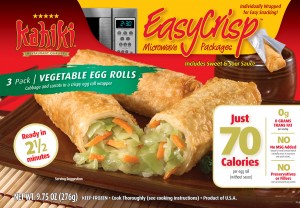
Food manufacturers have been hard at work creating low-fat and low-cal egg rolls that serve up heaps of taste, but not heaps of weight. When it comes to store-bought egg rolls, we love both Kahiki’s new veggie egg rolls and Trader Joe’s. So we’ve decided to pin them against each other in a food fight. Here are how their stats stack up: Read Full Post >
Who doesn’t love a crispy egg roll before they dig into their cashew chicken? But did you know that the average egg roll at your favorite Chinese restaurant can have almost 400 calories and up to 16 grams of fat?
Recently, I had the chance to sample Kahiki Food’s egg rolls. Not only are they yummy, but their egg rolls contain just a fraction of the calories that most restaurant egg rolls do. The veggie egg roll comes in at 70 calories, the chicken has 80 calories and their pork and shrimp combo comes in at a mere 100 calories!
And these aren’t mini egg rolls either. They are your average-sized egg roll packed with tons of veggies, like cabbage, carrots and water chestnuts with a spicy peppery flavor and a crispy egg roll crust. And they are the first microwaveable egg rolls that retain their crunchy crust even after they are nuked. Read Full Post >