Diets in Review - Find the Right Diet for You

cereal


Honey Smacks Top List of Most Unhealthy Cereals

Honey Smacks Cereal BoxKellogg’s Honey Smacks cereal is over 50 percent sugar by weight, putting them at the top of Environmental Working Group’s list of the ten worst cereals. The organization, dedicated to protecting children’s health, analyzed 84 popular brands, finding that only one in four brands meet appropriate nutrition guidelines for children.

The Interagency Working Group on Food Marketed to Children was formed by Congress in response to rising levels of childhood obesity. The group is exploring the possibility of setting advertising standards for foods with high levels of sugar, salt and fat. However, lobbyists are fighting back on behalf of cereal manufacturers, who spend millions on marketing sugary breakfast foods to parents and kids alike. Currently, the industry has set a voluntary standard for the sugar content of cereal by weight at 38 percent, while the USDA recommends a limit of 26 percent.

After Honey Smacks, sugar also accounted for more than half of Post Golden Crisp’s weight, but were closely followed by three Quaker Oats products. “The cereals on the list are relatively higher in sugar because the sugar is reported as a percentage of the cereals’ weight,” commented Registered Dietitian Mary Hartley. “Since these cereals are light and airy, there have relatively more sugar by weight.” However, when kids eat sugary cereal, they’re missing out on more important nutrients. “The main problem with sugar for healthy people is that it ‘displaces calories’ from foods that contain nutrients – vitamins, minerals, fibers, compounds with antioxidant activity, etc. – replacing those calories with a food that contains only energy from carbohydrate,” said Hartley.

“I was stunned to discover just how much sugar comes in a box of children’s cereal,” said Environmental Working Group’s Senior Vice President of Research Jane Houlihan. “The bottom line: most parents would never serve dessert for breakfast, but many children’s cereals have just as much sugar, or more.”


Read Full Post >


Food Companies Change Child Marketing Standards

A group of major food companies, including General Mills, ConAgra Foods and Kellogg, have announced that they will be voluntarily setting new advertising standards in order to cut back on marketing unhealthy foods to children. This comes after rejecting similar guidelines proposed by the federal government.

Under these new self-imposed standards, the food companies can still market their products to children, but only if they meet specific nutritional criteria. If they still want to market to children, some foods may have to make their ingredients more healthful.

“Now foods from different companies, such as cereals or canned pastas, will meet the same nutrition criteria, rather than similar but slightly different company-specific criteria,” said Elaine Kolish of the Children’s Food and Beverage Advertising Initiative, a group formed by the food industry.
Read Full Post >


Weetabix Cereal Paying Children to be Mobile Advertisements

“So, wait?! You’re going to pay my child $400 to wear a shirt with your company’s logo on it?”

This may very well be the line that has recently dropped out of many parents’ mouths as Weetabix, a popular cereal brand in the U.K., has been experimenting with a whole new type of advertising.

Weetabix is a whole grain cereal similar to America’s shredded wheat-style cereals. The company has begun hiring children with very busy social lives to wear the company logo while they attend their extra-curricular events. In return, the children are earning about $400. The company is intending to send the message that children who eat Weetabix can pack more into their day than their friends who opted for a different breakfast.

This move hasn’t come without controversy. Many opponents of this campaign are claiming that children are being sold as mobile billboards. As these socially active kids attend their clubs and run the sports fields, they are reaching a whole new market of potential consumers.


Read Full Post >


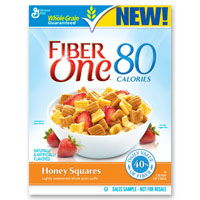
We Love Fiber One 80 Calories Honey Squares

Like any other child-at-heart, I love cereal. Whether it be a small bowl with breakfast or an afternoon handful, I simply can’t get enough. Cereal can be a good source of nutrients but it can also be an even better source of excess sugar (among other things.) While some cereals are falling to the wayside in a quest to introduce healthier foods to the masses, Fiber One has created a new option for cereal-lovers.

According to the nutrition panel, each ¾ cup serving of the Fiber One 80 Calories Honey Squares contains only 140 mg of sodium and a whopping 10 g of dietary fiber- that’s 40 percent of your recommended daily value! The ingredient list boasts whole grain corn as the number one ingredient but it also contains sucralose, which is fine in moderation although I personally prefer a natural sweetener.

It tasted great as a morning meal and I tried it with both vanilla almond milk and regular skim milk on different occasions. The texture was light and crunchy and it was very filling. I also tried it on top of a yogurt parfait and it added just the right touch of crunch without the amount of sugar that’s in the granola I usually splurge on.


Read Full Post >


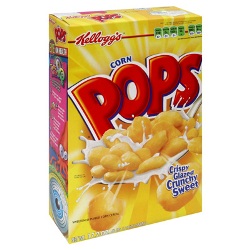
Corn Pops Cereal to Leave Shelves for Good in 2012

Blame it on rising corn prices or blame it on the embalming fluid, either way, say goodbye to Kellogg’s Corn Pops cereal.

In a category of food that produced over $600 million in revenue last year, Corn Pops only made $74 million, an 18% decrease since the year prior. The breakfast food that is advertised as being “crispy, glazed, crunchy, sweet,” can no longer compete with its peers. Cereals like Cheerios and Frosted Flakes made over $200 million last year.

Not only are big name cereals beating out Corn Pops but the sales of private brands have impacted totals.

Some have argued that the recent price hikes in corn are the culprits behind the demise of this long standing brand. There is some validity to that claim. However, one has to wonder if it’s the ingredients of the cereal that have really lead to the poor sales. Sure, the cereal is “crispy, glazed, crunchy, sweet” but what makes it so?


Read Full Post >