

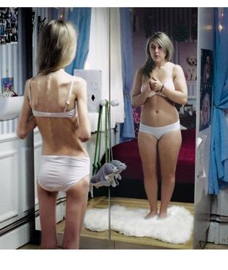





Tracey Gold is a well known Hollywood name. She’s known for he long time role on the series Growing Pains but she’s almost just as well known for her public battle with anorexia. Gold was one of the first celebrities to go public with her disease in the 90’s and since has been an advocate for educating people about eating disorders. Taking that role to another level, Gold has recently debuted a show on Lifetime titled Starving Secrets with Tracey Gold. In the unscripted series,
Gold works one-on-one with women struggling with eating disorders. The show is aimed at helping these women who are in life threatening situations, however, criticism has risen. Many fear that Starving Secrets, and shows like them, may do more harm than good.
In the dark world of eating disorders, like anorexia and bulimia, there seem to be a lot of secrets. The patients who struggle tend to be very reclusive and hidden. They basically have to be, because if the world saw what they were doing, someone might try and stop it. Critics fear that the show will provide more secrets for the afflicted to use, almost as if the show will become a new guide book or manual to further their disease. Professionals fear that while the show truly wants to help, it may inadvertently trigger viewers or even challenge those struggling to get competitive. For example, if the woman on the show is only eating 800 calories a day, the viewer may strive to only eat 500. Eating disorders are tricky and it’s very debatable what will help and what will hurt.
Brooke Randolph, a licensed mental health counselor, shared her thoughts about the show.“I agree with the other experts who are concerned that this may pose more danger than potential good. Those who suffer from eating disorders are often looking for new tactics and ideas to help them lose weight. The road to recovery is long and complicated, and it cannot be fully displayed in a single episode or even season. Ms. Gold likely wants to help others feel less alone in their suffering and make a difference to as many as she can. Unfortunately, like so many endeavors, the best of intentions can actually cause more harm than good.”
Read Full Post >
It’s hard to realize sometimes that celebrities are regular people just like the rest of us. They struggle with things like weight, exercise and self image. Jane Fonda has been in the spotlight for decades for her long acting career and having produced and starred in over 20 exercise DVDs since 1982. But Jane Fonda recently revealed to Harper’s Bazaar some of the struggles she’s dealt with in the past, like bulimia and poor body image.
Fonda spoke candidly about growing up in the 1950s and how her father influenced her body image. She said, “I was taught by my father that how I looked was all that mattered, frankly. He was a good man, and I was mad for him, but he sent messages to me that fathers should not send: Unless you look perfect, you’re not going to be loved.”
Fonda also talked about her battle with bulimia which went on for decades. “I wasn’t very happy from, I would say, puberty to 50? It took me a long time. It was in my 40s, and if you suffer from bulimia, the older you get, the worse it gets. It takes longer to recover from a bout.” Shortly after Fonda made the choice to end her battle with bulimia, she started producing and starring in her workout videos as a form of empowerment.
Read Full Post >
Is there someone in your life whom you worry might have an eating disorder? Do you know how to recognize symptoms of an eating disorder? While some symptoms are obvious, some are simply exaggerations of healthy behaviors taken too far.
One obvious symptom of an eating disorder is weight loss or weight fluctuation; however, this does not apply to everyone with an eating disorder. Meghan Bennett, Recovery Care Specialist of Selah House, LLC reminds us that “someone struggling with bulimia or ED NOS (Eating Disorder Not Otherwise Specified) may not experience much weight loss, may be over weight due to binging and purging, or not lose weight rapidly or drastically. The stereotype is that someone must be severely underweight or losing rapidly to have an eating disorder is misleading. Nearly half of the clients I work with in an inpatient ED facility have to do little to no weight restoration.”
Read Full Post >
There is good news and bad news. The bad news is that more than half a million adolescents in the United States could qualify for a diagnosed eating disorder according to research published at Archives of General Psychiatry. The study included structured interviews with more than 10,000 teenagers and their parents. The good news is that more than half a million is just under three percent of adolescents.
It is estimated than 0.3 percent of teens will suffer from anorexia nervosa, 0.9 percent will suffer from bulimia nervosa, and 1.6 percent will suffer from binge-eating disorder. Although many of the kids will experience some mental health treatment, it is generally not eating disorder specific.
While I am glad to read a low percentage of teens experience eating disorders, it is essential that proper treatment is provided to those kids that need it. Eating disorders require special treatment by a trained professional and often a team of professionals. The best treatments with which I am familiar include medical professionals, nutritionists, counselors, psychiatrists, and peer groups. Eating disorders are complicated syndromes that must take into account and treat a variety of factors.
Read Full Post >
The former child star who captured the hearts of fans as D.J. Tanner on Full House, Candace Cameron Bure was not exempt from the pressures of growing up in the public eye. In her new book, Reshaping It All, Cameron Bure reveals that she suffered from bulimia and discusses her path to recovery.
The actress appears on the cover of next week’s edition of PEOPLE magazine. “It’s a very dangerous cycle that can just start to consume your life and really take over,” she told the magazine. “It wasn’t about me trying to lose weight,” said Cameron Bure. “It was all about emotions.” Her eating disorder peaked after Full House ended its run.
Read Full Post >