
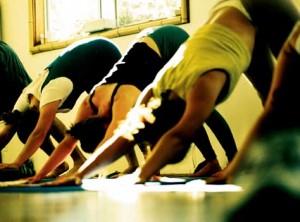

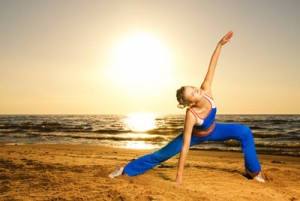

If you could only inhale hundreds of thousands of dollars straight into your bank account and exhale your spare tire from your middle-aged torso, life would be perfect, wouldn’t it? Sure, Hippocrates believed, “air is a pasture of life and a greatest ruler of all,” because we all need air to stay alive. And yes, your yoga teacher sings the praises of deep, abdominal breathing for inner peace and a clear head. Perhaps you’ve owned, seen or have known someone who bought the classic 1980s breathing exercise video, led by a slender woman in a leotard with hair like Farrah Fawcett, who makes us believe breathing is the way to a slim physique.
Whatever your experience has been with people suggesting that breathing air is life’s best elixir for weight loss and good health, there is now a new item on the market that claims their product is better than any weight loss pill or potion.
Brought to you by a team of international scientists, Breathslim is the latest device said to promote fat loss with practically no effort. Built out of a tiny container that holds water with an attached breathing tube (much like something you might have seen at a college party), the Breathslim device claims to bring more oxygen into the body.
Okay, so what? Fitness experts will tell you that the more oxygen that is consumed by the body, the more fat the body will use as fuel. This is true, however the body’s capacity to burn heaps of fat is highly dependent on aerobic fitness. In other words, you have to train your body with aerobic exercise in order for you to be a better and more efficient fat burner.
Read Full Post >
Being under stress is not fun. Tension headaches, insomnia, and back pain are just a few symptoms of taking on too much. These symptoms are uncomfortable to say the least, but if not addressed, they can lead to more serious, health-threatening ailments.
According to the American Psychological Association, one half of Americans say that stress has a negative impact on their personal and professional lives, adding that stress is responsible for keeping them up at night. The American Institute of Stress claims that workplace stress costs more than $300 billion dollars each year in health care, and according to the National Institute for Occupational Safety and Health, stressed out workers incur an average of $600 more a year due to stress related needs compared with non-stressed out workers.
Whether you work, are retired, or are a stay-at-home mom, if you are under stress, please take note of the following five tips for releasing tension from your life. Not only will it help you, it may even relieve the stress from those around you.
Read Full Post >
Many people will be hitting the ski slopes over President’s Day weekend, and lift lines will continue to grow through spring break and beyond. The air may be thin at the top of the lift but that doesn’t mean you won’t be able to breathe. In fact, Anne Anderson, a certified ski instructor from Mohawk Mountain in Connecticut, takes advantage of the fresh mountain air by teaching her skiers breathing and meditation practices as part of her lesson plan.
Snowga, a combination of the two words ‘snow’ and ‘yoga’ is the latest hybrid yoga class to hit the slopes. A blend of yoga and skiing, Snowga helps to improve your downhill skiing skills by incorporating yoga poses, breath work, and meditation. Created by Anderson, Snowga also helps skiers face their fears of the mountain and stay calm and relaxed on difficult terrain. “Yoga has a natural benefit of healing. It calms the mind and body and is a true compliment to snow sports education,” Anderson told Fox News in a recent interview.
Anderson is not the only skier who practices yoga on and off the slopes. U.S. Ski Team freestyle mogul skier Heather McPhie adds a little yoga to the days she skis. “It is so helpful in keeping my body more physically prepared and is a wonderful pause in my day where I get away from everything else and just center,” McPhie also explained in her interview with Fox News.
Read Full Post >
A study conducted by two Harvard University researchers suggests that people’s wandering minds are to blame for their unhappiness. In addition, they found that happiness was not necessarily a consequence of what someone was doing, but how focused they were while doing it.
Using an Internet-based cell phone application to gather feedback, the researchers asked their subjects if they were focused while engaged in certain activities, or if their minds were drifting towards something totally different. The subjects were then asked to describe their level of contentment during each activity.
The results concluded that people’s minds wander at least 50% of the time and while the mind is wandering, most people feel unhappy. It is worth noting that in this experiment minds wandered less during sex, exercise or while engaged in conversation and more in those who were working, using a home computer or resting. However you want to interpret this, the important message is that we only spend half of our waking hours focused and experiencing happiness.
Do you want to be happy more than 50% of the time, whether you are working, exercising or spending time with others? The following tips will help you focus, and “be here now” as esteemed spiritual leader Ram Dass famously states.
Read Full Post >
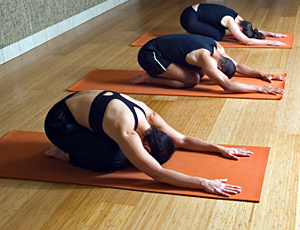
During this hectic time of year your yoga practice is especially helpful in reducing anxiety, but if you cannot fit in a full yoga class, practicing on your own is second best. Restorative poses like forward bends top the list to release stress and refresh the mind and body, but it is important that they are done correctly.
The following principles are categorized by body part and action to help you practice safe and effective restorative forward bending yoga poses.
Hips
Imagine your pelvis as a bowl of water and your spine as the stream of water that spills from the bowl. By placing both hands on your hips and tipping your hips forward first as if to pour the water onto your feet, you set the forward bend up from your hips rather than from your lower back. This prevents the action of lumbar lordosis (rounding out) from your lumbar spine, which can stress the discs of the lower back.
Knees
If your hamstrings are tight, simply bend your knees. This will allow your pelvis to tip forward with ease without rounding your lower back. Also, you can bend your knees if you feel tension behind them and if you feel a tugging sensation on your sitting bones. It is best to feel the stretch in the belly of the muscle, rather than at the attachment points (sit bones and backs of knees). This helps to protect your tendons and ligaments from excess strain.
Read Full Post >