Everyone experiences a bad mood every now and then. However mild or severe your gloomy attitude may be, the practice of yoga can lift your spirits so you can say goodbye to your bad mood for good.
The following are a few examples of how yoga can help turn your frown upside down.
Elevated GABA levels
Researchers have found that practicing yoga can raise the brain’s level of gamma-amino-butyric acid, which is the brain’s primary inhibitory neurotransmitter. When GABA levels are low, we can experience anxiety, depression, and a decreased zest for life. When GABA levels are high, we feel elated, happy, and interested in living life to the fullest. (more…)
“You look great! But I should not be wearing sleeveless shirts. Look at my arms jiggle!”
Sound familiar? If so, you are one of the many women who engage in fat talk. Simultaneously, a method of fishing for compliments and tearing yourself down, fat talk is something that simply needs to stop.
In a recent study, 93 percent of college-aged women admitted to engaging in fat talk. It’s something that has become part of how women speak with each other.
“Even if you don’t feel that way about your body, women talk that way as if that’s how they should be talking,” said Jan Hoffman on the Today Show. She also wrote about the topic in a recent article for the New York Times. Fat talk has invaded our conversations and our culture. (more…)
Don’t look now but people are making something out of nothing, again. We condemn celebrities for being too heavy, for being too thin, and it seems now those who are just at what is a healthy, normal weight for themselves. When will it stop?
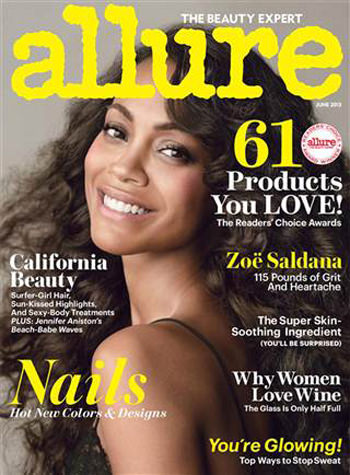
Zoe Saldana‘s donning the cover of Allure magazine this month and while people should be talking about her talent showcased in the upcoming Star Trek sequel, or even her activism with organizations like the Wounded Warrior Project, we all have to stop and waste blog space, morning show air time, and breath discussing the importance or relevance of telling the world this woman weighs 115 pounds. Quite frankly, who cares?
The five-foot-seven-inch actress told Today’s Savannah Guthrie that she has just always had a thin frame. And so that is the way the world, and nature, works. Some people are born with very thin frames, some people are born with large frames, and some people are born with your regular ‘ole run-of-the-mill frame. But, alas, it’s not all that simple. We were told “An image like this can activate a schema for a person to think they’re fat compared to this person,” by Jennifer Thomas, Ph.D., assistant professor of psychology at Harvard Medical School and assistant director of the Eating Disorders Clinic and Research Program at Massachusetts General Hospital.
According to Thomas, most adult women aren’t going to be as thin as Saldana. In fact, she reminded that most adult women couldn’t reach a body shape like that without severely limiting her intake.
Saldana defended Allure’s decision to publish her weight on the cover, suggesting that they were trying to draw a comparison between such a small person having such a strong personality and drive. “115 pounds of grit…” reads the line that is apparently fodder for controversy. The way I see it, if she doesn’t mind the world knowing how much she weighs, why should the rest of us? Actresses aren’t shy to speak up when their images have been Photoshopped to a fault, and if Saldana has all the grit Allure suggests she has, I imagine she would have taken a stand about this.
Rachael Leone wrote at Yahoo! that the publication of her weight was “unnecessary,” saying that just when it seems we’re making progress in the portrayal of women in magazines we take a step back again. Cheryl Phillips at Examiner asked if a similar headline would have appeared had Saldana been heavier. Thomas pondered over the value, too, suggesting that publishing the weight didn’t give us any additional data. “We can look at her and see that she’s tall and thin.”
If you want to talk medically, Saldana’s BMI is an 18.0, which, according to the CDC, puts her in the underweight category; something Thomas confirmed. Her medical care, nor that of any other individual, isn’t really any of our business (heard of HIPPA?), but if we wanted to make a case of this for the sake of Zoe’s health, we could raise that argument. But frankly, there doesn’t seem to be anything unhealthy about the way she lives.
The actress is a regular at Pilates and works with a personal trainer. As well, she partakes in active vacations like snow skiing. She appears to have a balanced approach to her diet, which is eating what she likes but staying active enough to counteract the pasta she admits to over-indulging in sometimes. She abides by the mantra that we only live once.
So, as I said, who cares if Zoe Saldana is 115 pounds? I weigh 140 pounds. There, it is. I don’t expect anyone is going to stop the presses for that information. I take care of myself, I’m comfortable in my own skin, and I’ve worn the same size jeans since college, something that didn’t change before/during/after my pregnancy. I think Allure would find I’m as gritty and strong as Zoe is and I don’t know that the fact that I do it in a slightly weightier package than the star makes a difference.
Abercrombie & Fitch CEO Mike Jeffries makes no buts about his company’s target demographic: really, ridiculously, good looking people. Jeffries has been at the helm of A&F for 18 years, and has sexualized the brand to near soft core pornography status. If you’ve ever been in one of the chain’s stores—more akin to a club with its pungent fragrance and techno racket—you’ve probably noticed the lack of women’s size XL and XXL clothing. A&F also refuses to carry a women’s pant larger than size 10. They only carry men’s XL and XXL to market to beefy weightlifters and athletes.
These shallow tactics aren’t employed by accident. The company’s marketing strategy is solely geared towards their idea of “good looking” people. Jeffries told Salon in 2006, “It’s almost everything. That’s why we hire good looking people in our stores. Because good looking people attract other good looking people…We don’t market to anyone other than that.”
Along with not selling clothing that doesn’t fit Jeffries’ “good looking” criteria, A&F does not hire people they find too large or ugly. The hiring process is bizarre, with the manager scouting the store for attractive people and imploring them to apply. Of course anybody can apply, but the process takes place at a kiosk in the store, so the manager can give you the once over and file your app accordingly. (more…)
In the aftermath of the Oklahoma City Thunder‘s 29-point blowout over the Houston Rockets in the NBA Playoffs last week, a CBS Houston relationship columnist named Claire Crawford felt inclined to give sports blogging a shot.
Crawford’s first foray into this new medium was epic. She’s become a search bar staple, but not because of her prodigious basketball analysis. Here’s what she took away from the game: “The Rockets looked terrible in Game 1,”—obvious, but so far so good—”but some say they weren’t the only bad-looking people on the court.” The rest of the prose is a bit elementary, so I’ll sum it up for you. She more or less called Thunder cheerleader Kelsey Williams “too chunky” for her position. Queue the social media firestorm.
The passive aggressive jab at the beautiful and fit Williams has Claire Crawford—pen name of real life blogger Anna-Megan Raley—in some hot water. Disdain for Crawford/Raley has been universal, and support for Williams has poured in from all over the web. The reasoning behind Crawford’s criticism is all speculation, but one could assume she might have been trying to boost her own self-esteem. It’s also insane; Kelsey Williams is an athlete, and a gorgeous one at that. Maybe Crawford just wanted to get her 15 retweets of fame, or maybe it’s a reflection of our society’s sea change in perception of beauty. (more…)
What a difference a choice, a moment, a day, a year and five years makes! This week was my 5-year anniversary since I stood on the scale at the season 5 finale of The Biggest Loser as the confetti fell and I became the first female winner.
When I look back at my journey, the moment that made the biggest difference in my life was when I said “fine.” For so long I waited for something “big” to happen, to know my life was going to change dramatically. I didn’t realize waiting left me missing all the moments that could have gotten me to the life I wanted.
I finally said “fine” in a conversation with my mom on August 11, 2026. She was so excited that the Biggest Loser casting was going to be in my hometown, despite only finding out the night before. Back then I was a fully booked hairstylist and couldn’t afford to take the time off of work. However my mom said, “I couldn’t afford NOT to go.” My life changed forever as I replied: “Fine, go find out where I need to stand in line.” Just like that. FINE. I was so many emotions: nervous, shaky, excited, scared, and even on the verge of tears. But I surrendered with just one word. (more…)
Jillian Michaels teased the announcement of her spring tour last week via Twitter, but made the “Maximize Your Life” tour official today. It’s the first time Jillian is mobilizing her message, and the tour promises to make this an inspiring, motivating, life-changing experience.
It all starts April 4 in Winnipeg, Manitoba, continuing on through a total of 35 cities in Canada and the U.S., with the tour coming to an end in Toronto on May 21. There are a total of nine tour dates in Canada, with U.S. tour stops hitting every corner of the country.
“It’s time to ask why not you?” poses Jillian.
She’ll help you answer that question in an empowering two-hour show, and leave you more prepared and focused to live what she calls your authentic truth. It’s not just about the sweat, or inclines, or what you’re eating, Jillian will show a live audience what she does best on Biggest Loser – break through. She has an uncanny ability to help people get out of their own way, dig deep and look inside to find the answers. (more…)
A lot goes in to a good sex life, and for women it can be more of a mind game with our conscience than anything else: Are my legs shaved? How’s my breath? Am I bloated? What’s he really think of my naked body? It’s common for women to over analyze things and want everything to be perfect to be “in the mood,” but that can be the biggest antagonist of them all.
We’ve got four weeks to get you ready for a romping good Valentine’s Day night. So follow these four key tasks our experts have identified to help you work on body image, toning, flexibility, and a little weight loss. There’s a good chance you’ll be the one wanting to skip dinner and head straight to the sheets…
Body Image
We all have insecurities about our bodies, but realize how important a positive body image is for enhancing our sex lives.
“Even without changing your body, learning to love it (or parts of it) can do wonders for you in the bedroom,” says Brooke Randolph, LMHC, our resident mental health expert. “If you hate your body and want to hide it, it’s hard to really relax and be tuned into your partner and what you’re experiencing. When you feel good about yourself, you’re more likely to not only try to seduce your partner, but you’re more easily seduced by them as well.”
Jennifer Livingston of WKBT-TV (CSB affiliate) in LaCrosse, Wisc. recently received an e-mail from a viewer who called her out by saying she’s “overweight and obese” and that she should reconsider her physical responsibility as a public personality. He backed his harmful comments up by saying she’s not setting a good example to children when it comes to living a healthy lifestyle.
Instead of taking these harsh comments in the worst way possible and beating herself up over it, the morning show host fought back against the viewer on public television. “The truth is, I am overweight,” she admitted in a candid and honest segment. “You can call me fat and yes, even obese on a doctor’s chart. To the person who wrote me that letter, do you think I don’t know that? Your cruel words are pointing out something I don’t see? You don’t know me. You are not a friend of mine. You are not a part of my family, and you admitted that you don’t watch this show so you know nothing about me besides what you see on the outside — andI am much more than a number on a scale,” asserted Livingston.
She continued with an inspirational speech to her viewers by saying, “We are better than that bully. We are better than this email. We are better than the bullies that would try to take us down.” (more…)
There are so many challenge-based fitness programs out on the web and they are proving to be effective for many people. Accountability and encouragement seem to be the magic ingredient for many people to stay motivated. Under Armour has gotten in on this trend by introducing “What’s Beautiful,” a promotion encouraging women to set goals, share the process, and hopefully meet them. Oh, and they’re giving away sweet prizes along the way.
The process is very simple. At the What’s Beautiful site, any woman can set a fitness goal, any goal, and begin her journey to victory. They are asked to document the process by sharing photos and video on the Under Armour site. During the journey they are also encouraged to choose one of the daily challenges set by Under Armour trainers. As these challenges are documented, users can cheer on others who are working hard, too. Then, at the end of each week, Under Armour will give away swag bags full of gear to the women who they say, “are seriously bringing it.”
This weekly challenge and goal setting promotion is on until the end of November. At the end of that month, ten finalists will be chosen as the winning athletes, those who’ve documented what Under Armour sees as the most impressive, motivated, and monumental stories. These deserving ten women will win a trip to Clearwater, Florida to train with the elite Under Armour trainers. That is where the some of the top athletes in the world go to enhance their performances. In addition to the amazing training sessions, the winners will be treated to sessions with nutrition experts and spa treatments. (more…)
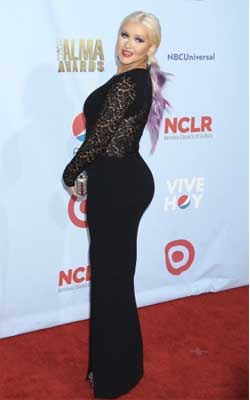
The woman made famous for her amazing voice has been getting much more attention lately for her voluptuous figure. Thirty-one-year old performer and mother Christina Aguilera is much curvier than she was when she first burst onto the scene as a teenage singing sensation in 1998.
Earlier this year, Christina was slammed for her weight after making concert appearances in scantily clad ensembles revealing a much curvier figure. Specifically, she drew much attention for her appearance at the Michael Jackson Tribute Concert after uncomfortably donning a tight corset and fishnet stockings during her performance.
The star admitted to drinking more after going through her divorce from former husband of five years, Jordan Bratman, and being lax on her diet.
Her poor diet choices and junk food binge eating slip-ups added up to lots of extra calories and plenty of weight gain. As a result, Aguilera’s weight has fluctuated drastically over the last several years.
Proof of this came just months after her Michael Jackson Tribute appearance when she was photographed looking much slimmer and seemingly “back on track” in terms of her health and her size. (more…)
Published content is provided from businesses that have been compensated by this website. This can potentially affect the appearance of the stated products. Not all companies or products are represented, but efforts are made to offer full transparency. Any and all published editorial content is offered without any sort of influence.