








Once in a while, a study comes around that just has to make health professionals a little squeamish. You know the kind – the ones that seem to not only contradict common sense, but also ends up as fuel for unhealthy people to justify bad eating habits.
This time around, a study is giving people who love their sweets a sweet surprise. Apparently candy and chocolate eaters tend to beat out those who don’t in the categories of waistline, weight, and body mass index (BMI).
But wait, there’s more.
Those in the study who ate candy and chocolate had a 14 percent lower risk of elevated blood pressure and a 15 percent decreased risk of metabolic syndrome (risk factors for heart disease and stroke).
Read Full Post >
Working mothers take note: According to a study in the journal Child Development, the longer a mother is employed is associated with an increase in her child’s body mass index (BMI).
The study’s co-authors analyzed 900 children and found the increase in children’s BMI which continued to grow as children got older. The study found that at a third grade level there was approximately a 1-pound gain for every six months the child’s mother worked. The weight gain was cumulative and the link became more obvious as the children matured into fifth- and sixth-grade.
Read Full Post >
Most health and fitness advice is full of don’ts: Don’t eat after 7, don’t eat fast food, don’t enjoy anything you eat, ever again. That negative connotation is why people view fitness and weight loss as a punishment, or something to be white-knuckled through.
Lasting change is made when you build a habit- and habits are made by systematically DOING something repeatedly until it becomes ingrained. Depriving yourself will not build habits, being proactive will.
So instead of pummeling you with more “don’ts” to make you feel like a failure, here are 50 things you can DO, today, that will improve your health. Pick one a day to try out, or choose one and repeat it everyday until it becomes a habit, but either way, these little “dos” will boost your health the second you do them.
Read Full Post >
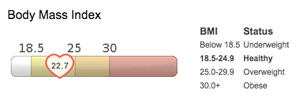
A massive study conducted by the National Institutes of Health (NIH) has calculated a new range of Body Mass Index (BMI) associated with the lowest risk of death from any cause in non-smoking adults. They determined that adults with a BMI between 20.0 and 24.9 are at the lowest risk of death. The study also gives a more precise estimate of the increased risk of death associated with being overweight and obese. The Centers for Disease Control currently define normal BMI as between 18.5 and 24.9.
“By combining data on nearly 1.5 million participants from 19 studies we were able to evaluate a wide range of BMI levels and other characteristics that may influence the relationship between excess weight and risk of death,” said Amy Berrington de Gonzalez, D.Phil., lead author of the study.
Read Full Post >
We all know how startling the latest obesity trend numbers are. It’s estimated that 38 states in the United States have an obesity rate of 25 percent in its population. It turns out, this increase in obesity is having a negative impact on societal norms. In fact, being overweight may be the new norm for women!
According to new research from the University of Texas Medical Branch (UTMB) at Galveston, more overweight women inaccurately perceive their body weight — but instead of these girls thinking of themselves as being heavier than they actually are (what you normally think of women doing), they are actually doing the opposite and categorizing themselves as at a “normal” or “healthy” weight, when in fact, they are not. The research will be published in the December issue of Obstetrics and Gynecology, and scientists say that this self-perception switch may make many women vulnerable to cardiovascular and other obesity-related diseases.
Read Full Post >