

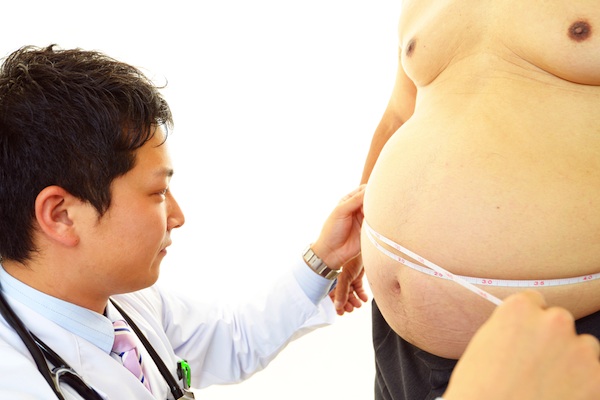






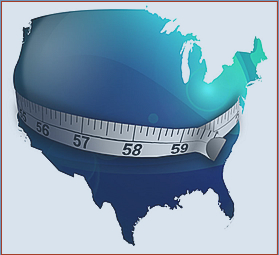
A report released jointly by the Trust for America’s Health and the Robert Wood Johnson Foundation shows that the percentage of obese or overweight children is at or above 30 percent in 30 states, and adult obesity rates increased in 23 states and did not decrease in a single state in the past year. The study, titled F as in Fat: How Obesity Policies Are Failing in America 2009, reports that in 1980, only fifteen percent of Americans were classified as obese, but that percentage has more than doubled, with more than two-thirds of Americans officially classified as overweight or obese. Let’s look at these numbers for a minute. What does it mean to be “overweight or obese”?

Once in a while there emerges health news that makes everyone scratch their heads. Here comes one of those moments…
If you are overweight – but only a little bit – congratulations, you are probably going to live the longest of any of us. That’s right, according to a new study people who were overweight, but not obese, were in prime position to outlive everyone else.
In the study, published in the journal Obesity, experts followed people 25 and older for 12 years. What they found was that people in the body mass index range of 25-29.9 were 17 percent less likely to die than those who were normal weight (a BMI of 18.5-24.9). Those who were underweight, a BMI less than 18.5, were 73 percent more likely to die than those who were normal weight.

A new report was published today by the Institute of Medicine (IOM) regarding weight gain of pregnant women. Not since 1990 have the guidelines regarding weight gain during pregnancy been reviewed. In the past 20 years, the demographics of pregnancy have evolved and as such, it is clearly time to rethink the information being provided to pregnant women and their caregivers.
There is now more diversity amongst pregnant women than there was in 1990, as well as more multiple births and pregnant women tend to be older than they used to be. The most daunting statistic is that more women today become pregnant while overweight or obese, and continue to gain weight, putting themselves at risk for chronic disease and increasing health risks for the baby.

There has been a lot of confusion about BMI over the years. BMI stands for Body Mass Index and is a statistical measure of the weight of a person scaled according to their height. Body Mass Index is calculated by dividing your weight in kilograms by the square of your height in meters.
Example for a 132 pound, 5′4″ female:
59.87 kg / 2.640625 m = BMI 22.7

According to the BMI chart, 18.5 or less is considered underweight, 18.5 to 24.9 is normal weight, 25.0 to 29.9 is overweight, and 30.0 and greater is considered obese.

Massachusetts took a major step forward today in the fight against childhood obesity by unanimously voting to screen children in the state’s public schools for obesity. A record of a child’s BMI will be sent home to parents, nicknamed the “fat report card.”
In Fall 2009 the screenings will begin, and students in grades 1, 4, 7 and 10 will be tested. Parents will have the option to opt-out. In addition to the BMI (Body Mass Index), which is a standardized method of determining how under or over weight a person is, the report card will also share ways in which parents can help their child’s weight and encourage parents to meet with a pediatrician.
