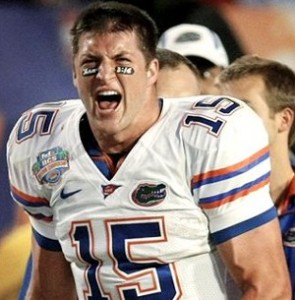


Tim Tebow, quarterback of the Denver Broncos, is one of the most talked-about NFL players this season. While sports commentators have questioned Tebow’s abilities as a quarterback, others have wondered exactly what it takes to stay in peak shape as a professional football player. For many professional athletes, including Tebow, maintaining an athletic physique is not something that comes naturally but is a result of years of dedication to strength training, cardiovascular exercise and maintaining a healthy balanced diet.
Though Tebow’s autobiography Through My Eyes states that he was raised on “Coke and Popsicles” at his uncle’s farm, it is unlikely that he maintains a high-sugar diet today.
“Every athlete will have different needs, but typically you’d like your athlete to eat cleanly all year long,” said New York-based performance coach Chris Matsui, who has worked with high-level athletes including the Carolina Panthers. ”A football player’s diet shouldn’t change drastically in the week before a game, but what they specifically eat is dependent on their individual needs and food allergies or intolerances.”
For most of his clients, Matsui recommends fueling with plenty of lean meat (fish and chicken), healthy fats (avocado and nuts), fruit (blueberries and strawberries), vegetables (kale, broccoli and spinach) and complex carbohydrates (quinoa or brown rice).
Read Full Post >
By Kelsey Murray
Who says that Halloween is only for candy-fueled kids who dress up as scary monsters and the latest comic book characters? Well, maybe most people say that, but it doesn’t have to be true this year for you.
Here’s our list of healthy Halloween costumes for 2011! Be a great influence on your kids, show off your fit bod, or give your favorite home town athlete some love by drawing costume inspiration from healthy sources. Don’t worry, you can still have a piece of candy or two.
Read Full Post >
All women dread that certain time of the month. Many women feel like crawling into bed and not speaking to anyone for a week, let alone do any kind of physical activity. So how do female athletes play under the pain and suffering of their cycles and does it affect their performance at all?
A New York Times article discusses how or if the menstrual cycle affects the athleticism of female athletes. Because women have not been participating in athletic events for very long, the research on female athletics is still in its infancy.
A study researching female rowers in Europe found that they measured the same in strength, endurance, and overall fitness in every point of their cycles. Some of the women were on birth control, which affects the production of estrogen, and some were not. Some of the women were professional athletes and others were not. Each woman could perform the same whether she was ovulating, menstruating or somewhere in between.
Read Full Post >
Bryant McKinnie was a professional football player for the Minnesota Vikings. An offensive lineman, McKinnie signed a contract extension in 2006 that was worth almost $50 million dollars. It looked like McKinnie would be a long-term Viking, but he was recently cut from the team’s roster after he showed up to training camp, weighing almost 400 pounds. This is 65 pounds more than he weighed last year, and evidently, it was the straw that broke the camel’s back.
Judd Zugland, a reporter at the Minneapolis Star-Tribune, said that McKinnie’s weight gain was the “final straw” that allowed the team to dismiss him from their ranks. In the past, McKinnie has had several off-field issues such as being involved in a brawl in 2008 and was a key player in the infamous “Love Boat incident”, a sex party on a rented boat involving many members of the team, which was very embarrassing for the franchise.
In a sport where the players have to be big enough to clear the field for their teammates to score touchdowns and have to stop the other team from rushing the ball, shouldn’t bigger always be better? Surprisingly, no. These NFL linemen have to walk a thin line between being big but still athletic, and so overweight that it slows them down. It seems that the Vikings determined that McKinnie had finally gotten too big, and was no longer an asset to the football team.
Read Full Post >
Part of the joy in endurance running is that the athlete is afforded more calories than their couch dwelling counterparts. However, when a well-meaning non-runner says to me, “you get to eat whatever you want though, right?” I have to sadly answer no and explain how I believed that lie once too.
I began running with hopes that I could eventually eat junk food all day long and pay no penance for it. It took me just a few stomach churning runs to realize that I was wrong. For most runners, their performance is directly related to their diet.
“Junk in, junk out,” is the phrase nutritionist Diane Greenleaf likes to use as a reminder for how our body works. She pointed out that while training does lead to more calories being burned, it doesn’t replace the fact that the body needs nutrients. And it’s no surprise that our tasty junk food isn’t chock-full of vitamins.
Read Full Post >