








Diets in Review - Find the Right Diet for You

addiction


Soda vs Marijuana – Which Do You Think is Worse?

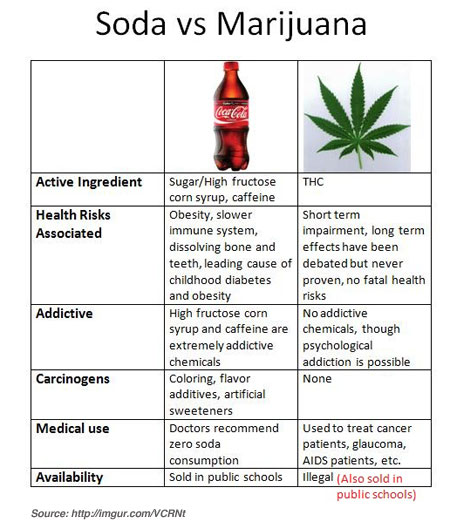
There’s a chart that has been floating around the Internet for a while comparing various health effects of soda and marijuana. The agenda doesn’t appear to be pro-pot as much as it is pointing out societal hypocrisy and the serious dangers associated with foods most of us have no moral issue with.

I would be the first to get in line with people who think the demonizing of marijuana in Western culture has always been taken to an extreme level. However, if you think it somehow comes without any serious health risks, you need to consider putting the bong down for a moment and read on. Let’s take a look at how soda and marijuana really compare:

Carcinogens - Let’s start with the biggest hole in the chart’s argument: that there are no carcinogens in marijuana. According to Donald Tashkin, MD, a researcher at UCLA’s David Geffen School of Medicine, there are as many or more carcinogens and co-carcinogens in marijuana smoke as in cigarettes. Inhaling carcinogens for a long period of time can’t be harmless, can it?
Read Full Post >


6 Reasons You May Be a Food Addict

People often say they are “addicted” to a food without much thought. But real food addiction is not something that should be taken lightly.

While it may be difficult to ever imagine comparing food and drugs, the difference in how people interact and react to each is not so different after all. People who suffer from food addiction exhibit some of the same behaviors and chemical reactions in their body as a drug addict.

Scientists are finding that food addiction begins in the brain. Here, there are chemical surges that affect a person’s response to food. These surges are very similar to those that occur with substance abuse.
Read Full Post >


Tune-In: Jillian Michaels Tackles Addiction on The Doctors

Be sure to tune in to today, Monday, September 19′s episode of The Doctors to catch Jillian Michaels on her newest TV gig.

Famous former Biggest Loser fitness trainer Jillian Michaels will be speaking up and sharing her thoughts on the American obesity epidemic. Michaels has just officially joined the cast for the new season and will also be continuing with her segment called “Wake-Up Call.” In these segments, Michaels is addressing the personal struggles of individuals.

On today’s show, Michaels will be confronting the subject of addiction. Michaels deals with three couples and three different types of addictions.


Four Lessons We Learned from Dr. Hoebel

Renowned Princeton physiological psychologist and researcher Bart Hoebel has died at the age of 76. He was a leader in research on eating behaviors and the addictive qualities of food. He seems to have been a professor that invested in his students, and we hope that some of them will continue his research in his absence.

Below are just some highlights of what Dr. Hoebel’s research has taught us.

Sugar is addictive and affects brain functions the same way as cocaine and heroin.

High-fructose corn syrup leads to more weight gain than ingesting the same amount of calories via traditional sugar. It also causes abnormal increases in body fat, particularly in the belly, and triglycerides.


Read Full Post >


Childhood Obesity is an Early Sign of Food Addiction

There is a new theory about the cause of the childhood obesity epidemic. Seattle-based pediatrician Robert A. Pretlow M.D.’s 10-year research was recently published in the peer-reviewed medical journal, “Eating Disorders,” under the title “Addiction to Highly-Pleasurable Food as a Cause of the Childhood Obesity Epidemic: A Qualitative Internet Study.” He has also released his full findings in book format in “Overweight: What Kids Say: What’s Really Behind the Childhood Obesity Epidemic.” The study suggests that children are displaying symptoms of addiction to salty, sugary, and/or fatty foods causing over-eating behaviors initially and obesity eventually.

The Diagnostic and Statistical Manual requires that at least three of the seven following symptoms are demonstrated for a diagnosis of dependence, which is more commonly understood as “addiction”:

  1. Tolerance – the need for more of a substance to obtain the same effect
  2. Withdrawal – physical or psychological symptoms accompanying decreased use
  3. Increased use over time
  4. Unsuccessful attempts and/or desire to decrease intake
  5. Time spent obtaining, using, and recovering from substance
  6. Neglecting other activities for substance
  7. Continued use despite adverse consequences


Read Full Post >